
What Is an AI Voice Agent? How It Works, What It Costs and Where It's Used
Reviewed by Ankur Handoo, Co-Founder, Hueman AI • Published October 2026 • 12 min read
Key Takeaways
- Real-time conversation and action: An AI voice agent doesn't just ask you to press 1 or record audio. It listens, understands natural speech across multiple turns, looks up live information in your booking or CRM systems, and replies in a natural voice.
- The latency challenge: Human conversation gaps average roughly 200–250 ms. Production cascaded voice agents target ~1.1 seconds across speech-to-text, LLM reasoning, text-to-speech, and telephony streaming.
- True cost breakdown: Per-minute software rates run ~10¢–20¢/min for usage, compared to human staffing where you pay for availability (National Living Wage floor of £12.71/hr = ~£111,000/yr for 24/7 single-line cover).
- Hospitality & small business sweet spot: High-value missed calls, out-of-hours coverage, and repeatable tasks (reservations, FAQ, guest requests) are the highest ROI entry points.
An AI voice agent is software that answers or makes phone calls, understands what the person says, decides what to do and replies in a spoken voice, in real time. A phone menu asks you to press 1. A voicemail box takes a message. An AI voice agent holds a conversation, and it can act on it: book an appointment, check an order, update a record, or pass the call to a person with notes.
The reason businesses are looking at it is simple: callers do not wait. In a YouGov survey of 2,046 UK adults, commissioned by call-answering firm Answer4u and published on 16 June 2026, 37% said they would give up on a business call within 60 seconds and try a competitor, and only 6% would leave a voicemail rather than wait (Answer4u and YouGov, 16 June 2026). In the US, a 2025 CallRail survey of 1,000 consumers found that 78% had abandoned a business after an unanswered call (reported by Beside).
Both are surveys of what people say they do, not measured call logs, and the first was commissioned by a company that sells call answering. They are still a fair reason to find out what these systems can and cannot do. This guide covers what an AI voice agent is, how a call works, what it costs, how it compares with a call centre, where small businesses start and how hotels and restaurants use it.
What is an AI voice agent?
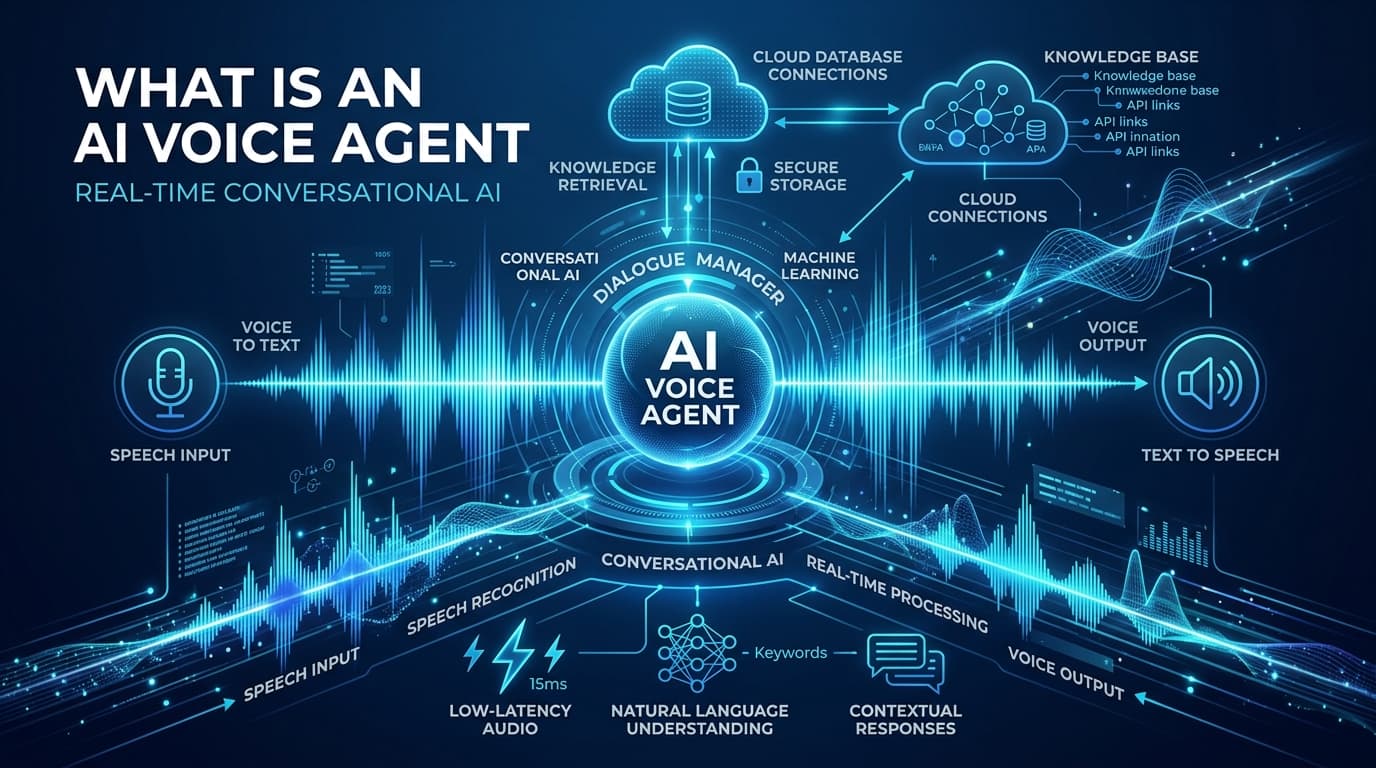
An AI voice agent is a conversational AI system that handles spoken conversations over the phone. It turns speech into text, works out what the caller wants, takes any action it is allowed to take, and replies in a synthetic voice. When a request falls outside its remit, it hands the call to a person (NICE).
AI voice agent, IVR, voice assistant or voicemail?
| System | How it understands the caller | What it can do | Main limit |
|---|---|---|---|
| Phone menu (IVR) | Button presses or a few fixed spoken words | Route the call or read out fixed information | Rigid; callers get stuck in menus |
| Voicemail | It doesn't; it records audio | Store a message | Nothing happens until someone calls back |
| Smart-speaker voice assistant | Single commands | Answer questions, control devices | Built for one person at home, not for a business phone line and its systems |
| AI voice agent | Natural speech across several turns | Hold a conversation, look things up, act in connected systems, hand over to a person | Needs a clear scope, accurate data and a good handoff |
| Human receptionist | Nuance and emotion | Anything, including judgement calls | One call at a time, and paid for availability |
How does an AI voice agent work?
A common design is what Twilio calls a cascaded architecture: speech-to-text, then a language model, then text-to-speech (Twilio). Some newer systems use a single speech-to-speech model that skips the text step. This guide follows the cascaded design because each stage can be inspected on its own.
The life of a call, step by step
- The call connects. A phone number or SIP connection routes the caller's audio to the platform. This is the telephony layer, and it is billed by the minute.
- The agent listens. Voice activity detection spots when the caller starts and stops speaking. Speech-to-text turns the audio into words, often while the caller is still talking. Judging the end of a turn matters: cut in too early and the agent talks over the caller; wait too long and it feels slow.
- The agent decides. A language model reads the transcript, the business's instructions and knowledge, and a list of tools it may use, such as a diary, a booking system or a CRM. It chooses what to say or do.
- The agent acts. If a tool is needed, for example to check availability or create a booking, the platform calls the business's system and feeds the result back to the model.
- The agent speaks. Text-to-speech turns the reply into audio. Good systems stream it, so the voice starts before the full sentence has been written.
- Handoff and record. If the caller asks for a person, or the agent reaches the edge of its remit, it transfers the call with a summary. The call is logged with a transcript and an outcome.
Why latency decides whether it feels natural
In everyday conversation the gap between one person finishing and the other starting is about a fifth of a second, and averages across ten languages stayed within roughly 250 milliseconds of one another (Stivers et al., PNAS, 2009).
A phone agent cannot match that. Every turn pays for transcription, the model, speech synthesis and the network. Twilio's worked example allows about 350 milliseconds for speech recognition, 375 for the model's first output and 100 for speech synthesis, and sets a target of about 1.1 seconds from the moment the caller stops speaking to the reply reaching their ear, with 1.4 seconds as the upper limit. Builders often aim lower, around 800 milliseconds, but there is no universally agreed threshold (Dasha).
One warning for buyers: a latency figure means little without its measurement boundary. How quickly speech synthesis returns its first audio is much smaller than the gap a caller actually hears. Ask whether the number runs from the caller falling silent to the reply reaching their ear.
What can an AI voice agent do, and what can't it?
Voice agents do best on structured, repeatable calls: bookings and rescheduling, opening hours and directions, order or case status, taking a message with the right details, and out-of-hours or overflow cover. They do worse on calls that are emotional, ambiguous or high-stakes, and on poor audio.
The usual failure points:
- Mishearing. Names, postcodes, reference numbers and unusual spellings are where speech recognition slips. Good designs read key details back for confirmation.
- Confident wrong answers. A language model can produce a plausible reply that is not in your data. The fix is to ground answers in your own information and tools, and to give the agent a clear route to 'I'll get someone who can help'.
- Talking over the caller. Interruptions, crosstalk and long pauses are hard to handle. Test with people who interrupt.
- Scope creep. An agent that can do everything will eventually do something you did not intend. Keep its permissions narrow.
Our view: start with calls where a wrong answer is cheap and a handoff is easy, then widen.
AI voice agent vs call centre
A call centre (call center in US spelling) or a human receptionist and an AI voice agent solve overlapping problems with opposite cost structures: you pay people for being available, and you pay software for being used.
| Factor | Human call centre or receptionist | AI voice agent |
|---|---|---|
| Availability | Limited by rota, breaks and time zones | Always on, if configured to be |
| Simultaneous calls | One per person | Many at once, up to your plan's concurrency limit |
| How you pay | For staffed hours, whether or not the phone rings | Per connected minute or a monthly plan |
| Consistency | Varies by person and shift | Same instructions and data on every call |
| Complex or emotional calls | Strong | Weak; should hand over |
| Languages | Depends on who you hire | Depends on the speech models used; test your actual languages |
| Quality control | Call sampling and coaching | Every call can be transcribed, but someone must read the failures |
| Ramp-up | Recruitment and training | Configuration and testing |
Concurrency is a plan setting, not infinity. Retell, for example, includes 20 concurrent calls on pay-as-you-go and sells extra capacity at 8 US dollars per concurrent call per month (Retell pricing; the included 20 per Macha's September 2026 check). For most organisations the realistic answer is both: the agent takes routine, out-of-hours and overflow calls, and people take the calls that need judgement.
How much does an AI voice agent cost?
Short answer: published platform prices run from about 5 to 31 US cents per minute, depending on what is bundled. A realistic all-in figure for a typical production phone agent is about 10 to 20 cents a minute: third-party reviews that price real configurations land at roughly 11 to 13 cents (AI Voice Review, Alatirok), and premium voices or models push it higher. Sector-specific products usually charge a monthly plan instead.
The five layers behind a per-minute price
| Layer | What it pays for | Published or estimated range per minute | Source |
|---|---|---|---|
| Platform | Orchestration: turn-taking, tool calls, logging | About 5 cents (Vapi's hosting fee) to 5.5 cents (Retell's voice infrastructure) | AI Voice Review; Retell pricing page |
| Speech-to-text | Transcribing the caller | About 0.15 to 2.4 cents | Softcery, 2026 |
| Language model | Deciding what to say or do | About 0.3 to 8 cents on Retell's standard-tier model list | Retell pricing page |
| Text-to-speech | Generating the voice | About 0.5 to 4 cents | Softcery, 2026 |
| Telephony | Phone number and carrier minutes | About 1.3 cents in a US example; UK carrier rates vary | Retell, 2025 comparison |
Adding the low ends gives about 7 cents a minute and the high ends about 21 cents (our arithmetic on those ranges), which sits inside Retell's published pay-as-you-go range of 7 to 31 cents per minute (Retell). Prices change often; these reflect vendor pages and third-party checks from September 2026.
Worked example: 1,000 minutes a month
1,000 minutes is about 330 three-minute calls. At 7 cents a minute that is about 70 US dollars a month; at 21 cents, about 210 dollars; at an assumed all-in 15 cents, 150 dollars. Ten times the volume costs ten times as much, because you are paying for usage. None of this includes set-up, integration with your booking system, testing, monitoring or a human fallback.
Cost of availability versus cost of usage
The UK National Living Wage rose to £12.71 an hour on 1 April 2026 (GOV.UK). At that floor a staffed hour costs about 21p a minute, which looks close to AI per-minute pricing. The difference is utilisation.
To cover one phone line around the clock you need 168 staffed hours a week. At £12.71 that is about £2,135 a week, or roughly £111,000 a year, before employer costs, supervision and training. If that line actually carries 40 hours of conversation a week (2,400 minutes), an AI agent billing at an assumed 15 cents a minute would charge 360 US dollars for the week.
This is illustrative arithmetic across two currencies, with no exchange-rate conversion; the gap is far wider than any plausible rate move. It only holds where you genuinely need round-the-clock or surge cover. A line that is quiet in the evenings may not need 24-hour human cover in the first place.
What the per-minute price leaves out
Integration with your booking or customer system, writing and testing the knowledge base, call review, a human fallback and any set-up fee. Ask vendors to price a fixed-scope pilot with integration itemised, and compare on cost per resolved call, not cost per minute.
Some sector products charge plans instead. Hueman AI's homepage FAQ lists a Starter plan from £299 a month for boutique and independent properties, with larger tiers priced on request; see the pricing page for the current position.
AI voice agents for small business
A small business rarely needs a big deployment. It needs the phone answered when everyone is busy.
Put a number on a missed call. Multiply your average booking or job value by the share of callers who would have booked. As an illustration with made-up inputs: 20 missed calls a week, one in four of which would have booked, at £60 each, is £300 a week. Replace the inputs with your own call log.
Where to start, in order of risk:
- After-hours and overflow answering: capture the caller's details and reason, then text a summary.
- Booking or appointment requests tied to your diary.
- Frequently asked questions: opening hours, location, prices, parking.
- Status checks or simple payments, once you trust the first three.
Three ways to buy
- Self-serve platforms (for example Retell or Vapi): you build the agent and pay per minute. Flexible, but you own the prompts, integrations and testing.
- Sector or managed products: sold as a service for a type of business, usually with integrations to that sector's systems and a monthly fee.
- Answering services that combine AI and people: a person backs up the agent.
A six-step set-up
- List your call types and pick the three to five you will automate first.
- Write the answers: hours, prices, policies and how to book, in one place.
- Connect the diary, booking system or CRM.
- Set handoff rules: who gets the call, when, and what the agent says.
- Test with 20 or more scripted calls, including interruptions, accents, background noise and awkward spellings.
- Launch on after-hours calls first, then read transcripts weekly for the first month.
When it isn't worth it. If you miss a handful of low-value calls a month, a clear voicemail greeting and a callback routine may be enough. The case for an agent grows with call volume, call value and how often your phone is busy at the worst moments.
Where AI voice agents are used
Common uses include appointment booking and reminders in clinics and salons, job intake for trades, order status for retailers, simple account queries in utilities and financial services, takeaway and table bookings in restaurants, and reservations and guest requests in hotels. The pattern is the same everywhere: the agent handles the in-scope request end to end and transfers the rest to a person with a summary. For outbound calls, UK rules on automated marketing calls (PECR) are restrictive, so take advice before using an agent to dial customers.
AI voice agents in hospitality
Our view: hospitality is a natural fit because the person who would answer the phone is frequently serving someone in person. One data point, with a caveat: voice-AI vendor Revmo analysed 12,091 US restaurant call recordings for its 2026 State of Calls report and found roughly four in ten quick-service calls went unanswered (Revmo). It is a vendor study of US restaurants, so treat it as indicative, not a UK benchmark.
What hotels and restaurants hand to a voice agent:
- Reservations and availability checks against the PMS or booking system
- Takeaway and in-room dining orders, routed to the kitchen
- Questions about rooms, menus, opening times, parking and policies
- Guest requests (towels, a cot, late check-out) logged as tasks for the team
- Group and event enquiries, qualified before they reach a manager
- Out-of-hours and peak-time overflow, in the guest's own language
What to check that is specific to hospitality:
- Rates and availability accuracy. The agent is only as good as the PMS data it can read. Ask what it can read and what it can write.
- Payments. Ask how card details are handled; many set-ups send a secure payment link instead of taking numbers by voice.
- Allergens and dietary requirements. Treat these as handoff topics unless the system has been built and tested for them.
- Peak behaviour. Test at your busiest times, with several calls at once.
Hueman AI's Voice AI Agent and AI receptionist pages describe reservation calls. Its AI Concierge and Request Agent categorises, prioritises and routes guest requests, housekeeping included, to the right team member and sends the guest live status updates; here is how that works day to day for housekeeping. The AG Hotels case study describes a Phase 1 deployment at a UK hotel group, built to replace an outsourced contact centre that handled about 40,000 minutes a month; the page is clear that its published figures are targets, not results. For the hospitality detail, read AI Voice Agents for UK Hospitality: The Complete 2026 Guide, and see the PMS compatibility guide for which PMS systems are published and verified.
How to choose and test an AI voice agent
A short checklist that works in any sector:
- Scope. Which calls will it handle, and which must it hand over?
- Latency. What is the caller-perceived gap, measured from the caller falling silent to the reply being heard?
- Real audio. Test with your own recordings: accents, background noise, interruptions, spelt-out names and numbers.
- Integrations. What can it read, and what can it write? Which of your systems are supported?
- Handoff. Does the person get a transcript and summary, and is the transfer warm?
- Reporting. Can you read every transcript, see outcomes and find the failures?
- Data protection. Where is audio processed and stored, for how long, who are the sub-processors, and is a data processing agreement available?
- Price. Per minute or per plan, what is excluded, and what are the contract terms?
Under UK GDPR a caller's voice and any recording are personal data, and fairness and transparency are core principles. Our recommendation is to tell callers at the start of every call that they are speaking to an AI. The EU AI Act also contains a transparency rule for AI systems that interact with people (Article 50), which can matter if you take calls from the EU; check current application dates with a specialist.
Questions people ask about AI voice agents
What is an AI voice agent?
Software that handles phone conversations: it listens, works out what the caller wants, takes actions in connected systems such as a booking diary, and replies in a synthetic voice, handing over to a person when a request falls outside its remit.
How does an AI voice agent work?
Each turn runs through speech-to-text, a language model and text-to-speech, carried over a phone connection. The model can call tools, such as a booking system, before it answers. Platforms stream every stage so the reply starts quickly; a typical target is about one second from the caller finishing to the reply being heard.
How much does an AI voice agent cost?
Published platform prices run from about 5 to 31 US cents per minute, and realistic all-in costs for a production phone agent are roughly 10 to 20 cents per minute. Sector-specific products usually charge a monthly plan. Ask for integration and set-up to be itemised.
Is an AI voice agent better than a call centre?
It depends on the call. An agent is cheaper per connected minute, always on and can take many calls at once, but it is weaker on complex or emotional calls. Most organisations end up with both: the agent takes routine, out-of-hours and overflow calls and people take the rest.
Are AI voice agents suitable for small businesses?
Yes, where a missed call costs real money and the calls are repeatable: bookings, enquiries, opening hours, messages. Start with after-hours and overflow calls, keep the scope narrow and read the transcripts weekly. If you miss only a few low-value calls a month, a good voicemail greeting may be enough.
Do I have to tell callers it is an AI?
There is no need to hide it and good reasons not to. UK GDPR rests on fairness and transparency, and we recommend saying so at the start of every call. The EU AI Act includes a transparency rule for AI systems that interact with people, which can apply if you serve callers in the EU. Take specialist advice on your own set-up.
What can't an AI voice agent do?
It cannot exercise judgement beyond its rules, reliably handle distressed callers or emergencies, or guarantee it has heard a name or number correctly. It also depends on the data it can read. Design for a quick handoff to a person.
Will it work with my booking system or PMS?
If the system has an API and lets outside software read and write, usually yes, but the details vary: what an agent can read is often broader than what it may write. Ask for the list of supported systems and test the specific actions you need. For hotels, our PMS compatibility guide lists what is published and verified.
Never Miss Another High-Value Booking Call
See how Hueman AI's Voice Agent answers calls in under a second, speaks in natural British accents, integrates with your PMS or booking diary, and hands over complex enquiries smoothly.
Next step
An AI voice agent is a conversation layer on your phone line: it answers fast, follows your rules, takes routine actions and hands over when it should. It is not a person, and the best results come from a narrow scope, accurate data and a clean handoff. Start by measuring your own missed and abandoned calls for a fortnight.
If you run a hotel or restaurant and want to see how Hueman AI handles calls, requests and your PMS, book a demo or read about the AI Concierge and Request Agent.
About Hueman AI
Hueman AI specialises in delivering cutting-edge AI voice solutions tailored for the UK hospitality sector. Our intelligent voice agents integrate seamlessly with your existing systems, delivering 24/7 service excellence whilst reducing operational costs. Discover how we're helping British hotels, restaurants, and hospitality venues transform guest experiences and boost revenue.
Contact us today to explore how AI voice technology can elevate your property's service delivery and competitive positioning in the UK market.