
AI Housekeeping Agent for Hotels: Automating Requests Without Adding Headcount
Reviewed by Ankur Handoo, Co-Founder, Hueman AI • Published October 2026 • 12 min read
Key Takeaways
- Coordination, not cleaning: An AI housekeeping agent automates the information loop around housekeeping—guest requests in, staff tasks out, and room status back into the PMS—leaving physical cleaning and standard inspection to people.
- Solving status lag: The gap between when a room is physically finished and when reception sees it ready in the PMS causes early arrivals to wait unnecessarily.
- PMS write-back boundaries: Modern APIs (such as Oracle OPERA Cloud and Mews) allow writing Clean or Inspected states, but taking rooms Out of Order remains a deliberate staff action.
- UK labour reality: With the National Living Wage at £12.71/hr and hospitality vacancies cooling, the economic gain centres on supervisor capacity, response times, and turnaround speed rather than cutting attendants.
A room is clean at 11:25. The front desk sees it as dirty until 11:45. In between, a guest who wanted an early check-in is standing at reception, and a supervisor is walking a corridor with a radio, relaying a status that no system knows yet.
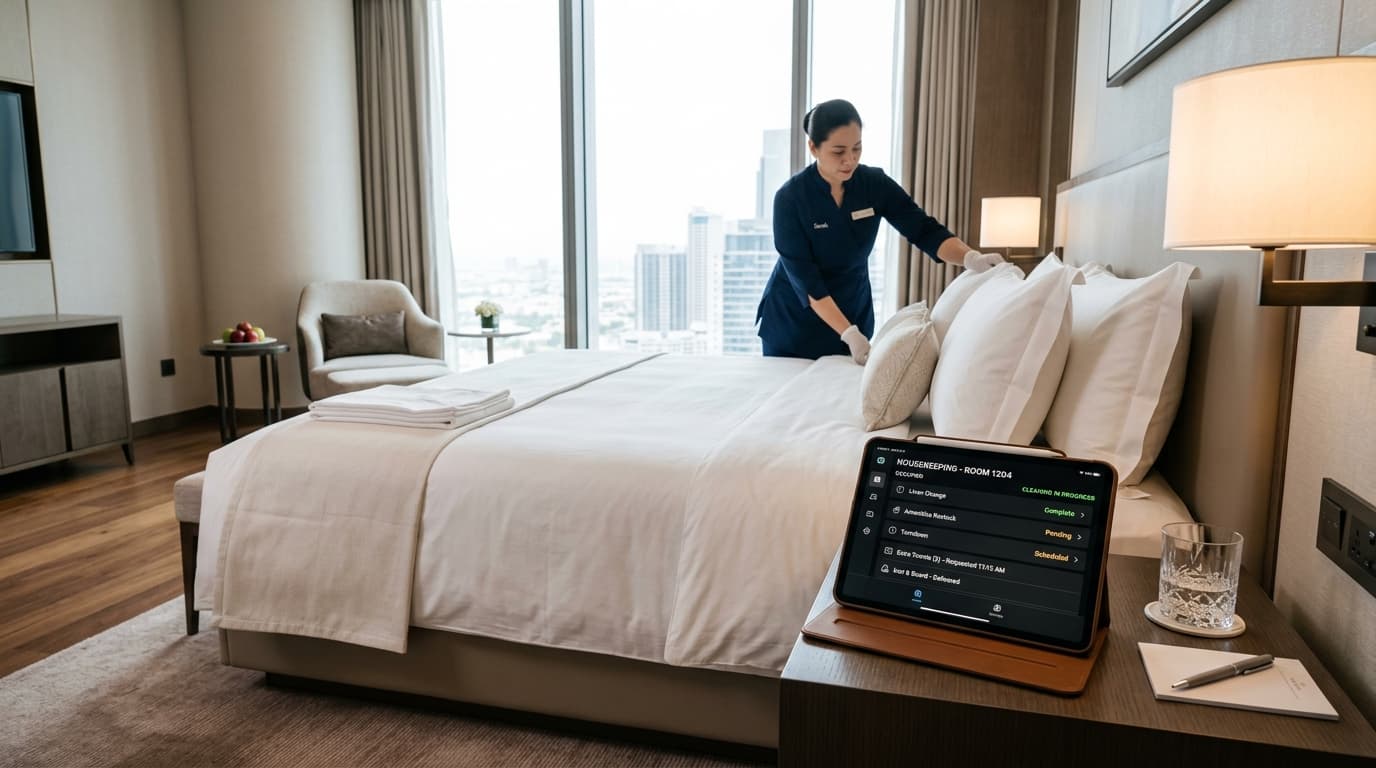
That gap, between the work being done and everyone knowing it is done, is where an AI housekeeping agent for hotels earns its keep. It does not make beds. It handles the information around them: requests coming in, tasks going out, and room status going back into your PMS.
In short: an AI housekeeping agent is software that reads live hotel data, turns guest and staff requests into assigned tasks, chases acknowledgement and updates room status in the PMS, handing anything outside its rules to a person. Done well, the same team handles more requests with less radio traffic. It will not fix a shortage of room attendants.
What an AI housekeeping agent actually does
Housekeeping is two jobs. One is physical: stripping beds, cleaning bathrooms, restocking. The other is coordination: knowing which room matters next, telling the right person, hearing back and recording the result. An agent works on the second job.
The coordination loop
Every housekeeping task, from a departure to a request for extra pillows, runs through the same six steps:
- Intake. Something arrives: a check-out in the PMS, a WhatsApp message, a phone call, a fault spotted by an attendant.
- Triage. Someone decides what it is and how urgent it is.
- Assignment. Someone picks the person and tells them.
- Action. The work happens.
- Verification. A supervisor checks it, where your standard requires it.
- Record. Status and an audit trail are updated where the front desk can see them.
In a radio-and-paper operation, people carry steps 1, 2, 3 and 6 from memory. Steps 4 and 5 are the actual work. An agent takes on 1, 2, 3 and 6 and prompts people at 5.
Agent, chatbot, software or robot?
Housekeeping software records and displays tasks. A guest chatbot answers questions. A cleaning robot performs a physical job, usually vacuuming or moving supplies through corridors. An agent differs from all three because it acts: it picks an allowed action in your systems, such as creating a task, reassigning a room or updating a status, and checks that it was done.
Who does what
| Task | The agent | A person |
|---|---|---|
| Read check-outs, arrivals and early-arrival flags from the PMS | Yes | |
| Triage a guest request (extra towels, a cot, a noise complaint) | Classifies it and creates the task | Takes anything sensitive or unclear |
| Assign the task and chase it | Sends it, tracks acknowledgement, escalates if ignored | Sets the rules and the escalation contact |
| Clean the room | Attendant | |
| Pass or fail the room | Supervisor | |
| Write Clean or Inspected to the PMS | Writes it when the person reports or confirms | Attendant reports done; supervisor confirms inspection |
| Take a room Out of Order or Out of Service | Flags it | Decides and records it |
| Rotas, breaks, performance | Manager |
A day in the life: radio calls versus an agent in the loop
This is an illustrative scenario, not a client case study. It follows one departure room, 214, on a morning when a guest is due in early.
Before: clean at 11:25, ready at 11:45
- 10:12 The guest in 214 checks out. The PMS shows the room as dirty.
- 10:15 The desk radios the supervisor: 214 is out and an early arrival is due at noon. The supervisor is mid-corridor and notes it on the paper list.
- 10:50 After one missed radio call (the attendant had a vacuum running), the attendant starts 214.
- 11:05 A guest in 308 messages the hotel on WhatsApp asking for extra pillows. It sits in the shared inbox until the desk has a free moment at 11:35, then goes to housekeeping by phone.
- 11:25 214 is clean. The attendant tells the supervisor, who inspects at 11:40 and radios the desk.
- 11:45 The desk marks 214 ready in the PMS. The guest, who arrived at 11:30, has waited 15 minutes for a room that was clean 20 minutes ago.
After: the same room with an agent in the loop
- 10:12 The check-out reaches the agent through the PMS. It sees the early-arrival flag on 214 and moves the room to the top of the queue.
- 10:13 The attendant covering that floor receives the task, with the room number, the reason for the priority and any note, on the device or channel the team already uses. The attendant acknowledges once. If nobody does within a set time, the agent tells the supervisor.
- 11:05 The agent reads the 308 message, classifies it as a housekeeping amenity request, creates a task for that floor's attendant, tells the guest it is on the way and closes the request when the attendant confirms delivery.
- 11:25 The attendant reports 214 done. The agent writes Clean to the PMS and tells the supervisor the room is ready to inspect.
- 11:30 The guest arrives. The desk can see that 214 was reported clean at 11:25 and is waiting on inspection.
- 11:38 The supervisor confirms the inspection. The agent writes Inspected, if your hotel uses that status, and the guest checks in. The wait is eight minutes instead of fifteen, and the desk can say why.
The cleaning took the same time in both versions. What changed is the time between steps and the number of people relaying information. This is the pattern, not a feature list: which steps are automated depends on your PMS, the channels your team uses and how the agent is configured.
How an agent automates housekeeping requests
To automate hotel housekeeping requests, an agent has to handle the part that arrives unpredictably, through every channel at once. Phone, messaging, chat and the front desk all feed the same pool of tasks.
A well-configured agent does four things:
- Understands the request as the guest wrote or said it, and sorts it: amenity, extra cleaning, do-not-disturb change, maintenance fault or complaint.
- Creates the task with room number, item and priority, and sends it to the right person or team.
- Keeps the guest informed with an acknowledgement and a completion message.
- Escalates what it should not handle alone: complaints, safety concerns and anything involving entry to an occupied room.
Set the boundaries before go-live. A towel request can be fully automated. A guest reporting no hot water is a maintenance task and a possible service-recovery moment, so it should reach a person with the context attached.
Staff requests deserve the same route. An attendant who spots a leak should not have to find the right radio channel. A short message to the agent should open the maintenance ticket and flag the room.
How room status updates reach your PMS
Room status is the field the front desk sells rooms against. AI room status updates are therefore the part of the loop that matters most, and the part that depends most on the details of your PMS.
Status codes differ by system
Oracle OPERA Cloud's housekeeping statuses are Clean and Dirty, plus two optional ones, Inspected and Pickup, which must be switched on in the property's OPERA controls (Oracle OPERA Cloud documentation). Out of Order and Out of Service are handled separately. Mews lists Dirty, Clean, Inspected, OutOfService and OutOfOrder as resource states (Mews Connector API documentation).
The practical point: if your property does not use Inspected, an agent built around it will wait for a status that never comes. Configuration matters as much as software.
What an integration can and can't set
Both systems let partner software write housekeeping status through their APIs. Oracle's integration guide tells partners to send Clean, Dirty, Inspected or Pickup through the housekeeping room-status operation, and to use dedicated operations for Out of Order and Out of Service (Oracle Hospitality Integration Platform documentation). Mews's resource update accepts any new state except OutOfOrder.
So an agent can mark rooms Clean or Inspected, but taking a room out of order is a human decision recorded through a separate route. Confirm the exact permissions for your own PMS version and configuration.
Rules worth setting before go-live
- Who confirms what. Our recommendation: let the agent write Clean automatically, and Inspected only after a supervisor confirms.
- What happens when a write fails. The agent should retry, alert a supervisor and show the desk that the status is unconfirmed, not drop it silently.
- Which system wins in a disagreement. Decide it up front, then test it.
Agent, app or PMS module? Choosing the right layer
Housekeeping automation software for hotels comes in layers. Two are familiar. An agent is a third that works alongside them rather than replacing them by default.
| Layer | Strong at | Weaker at | Fits when |
|---|---|---|---|
| PMS housekeeping module and mobile app | Native room status with no extra integration | Taking requests from phone and messaging; chasing and escalation | One PMS, a stable team, few channels |
| Dedicated housekeeping app | Assignments, checklists, inspections, maintenance flow | Needs its own PMS integration; usually doesn't triage inbound guest messages | Your problem is attendant workflow and inspection |
| AI agent layer | Intake from phone and messaging, triage, dispatch, reminders, status write-back | Depends on accurate PMS data and clear rules; can't do the physical work | Your problem is the relay between guests, desk and housekeeping |
Two points worth knowing. First, agents often feed an existing tool rather than replace it: Apaleo's Trace Agent at THE FLAG Zürich creates tasks inside the group's existing housekeeping tool, Sweeply (Hotel Management Network, 24 February 2026). Second, PMS vendors are adding AI, so check what has shipped for housekeeping. Oracle's 16 June 2026 announcement of OPERA Cloud Assistant lists staff guidance, AI-assisted matching of guests to rooms, rate descriptions and translation. Housekeeping dispatch is not among them.
'Without adding headcount': what that can and can't mean
The phrase invites a fair challenge, so here is the careful version.
Cost is a sharper pressure than scarcity. ONS data put UK vacancies in accommodation and food services at about 70,000 in the three months to July 2026, down from about 177,000 at the 2022 peak and below the 2019 average of about 92,000 (ONS series JP9O, 15 September 2026 release; it covers the whole sector, not only hotels). Meanwhile the National Living Wage rose 4.1% to £12.71 an hour on 1 April 2026, from £12.21 (GOV.UK, Low Pay Commission). Hiring is easier than it was, and each hour costs more.
What an agent can absorb is coordination time: relaying, re-keying, chasing and answering 'is 214 ready?'. That time sits with supervisors, receptionists and sometimes a housekeeping controller. AI for hotel operations staff is most useful where the work is passing information, not delivering the service. It lets a team take on more requests or occupancy without adding a coordinator.
What it cannot absorb is the cleaning. If you are short of attendants, software will not supply the minutes. It can stop wasting the ones you have.
How big are the gains? Early public numbers are modest. Apaleo and THE FLAG report that their agent creates around 30 tasks a day at the 101-room THE FLAG Zürich, saving an estimated 3.5 hours a week in task-creation time, with further gains from fewer messages between departments (the companies' own figures). That is one narrow task. Ask any vendor promising more for the baseline behind the number.
A cautious calculation (illustrative arithmetic, not a benchmark): at the statutory floor of £12.71, 20 minutes saved per attendant per day across eight attendants is about £34 a day before on-costs. Labour minutes alone rarely carry the case. The stronger argument usually rests on time-to-ready, response times and supervisor hours.
Measure your own status lag first
Before you talk to any vendor, measure how long information takes to travel in your hotel. You need a spreadsheet and about ten days.
Sample 30 to 50 departure rooms across a normal week and a busy one. For each, record:
- Check-out time in the PMS
- Time the attendant started
- Time the attendant finished
- Time inspection finished, if you inspect
- Time the PMS showed the room ready
Two numbers matter. Status lag is the time the PMS showed the room ready minus the time it was actually ready. Time-to-ready is the PMS ready time minus check-out. For requests, add the time from the guest's message or call to the task reaching an attendant, and the time to completion.
Then count the cases where lag cost something visible: early arrivals who waited, and rooms sold late because the status was stale.
Our rule of thumb: if typical lag is a couple of minutes, you do not have a coordination problem and an agent will not move much. If it is closer to the 20 minutes in the scenario above, you do.
What to ask any vendor, including us
These questions separate a working housekeeping agent from a demo:
- Which statuses does it write, to which PMS? Ask separately about Clean, Dirty, Inspected, Pickup, and Out of Order or Out of Service.
- Who approves what? Which actions are automatic, which need a supervisor, and who can override?
- What will attendants actually use? Handheld, phone app, messaging or voice, and in which languages? An agent that needs a new app on every phone adds work.
- What happens when something fails? PMS unavailable, a status write rejected, a message undelivered, an attendant who doesn't answer.
- Is there an audit trail? Every instruction, acknowledgement, completion and override, time-stamped.
- How is worker data used? The ICO's guidance on monitoring workers expects a lawful basis, openness with staff and, for high-risk monitoring, a data protection impact assessment (ICO). Ask whether the agent reports on individual attendants, and switch that off unless you have decided you need it.
- Where does guest data go? Controller and processor roles, hosting location, retention, sub-processors and whether a data processing agreement is available.
- What is the baseline and the measure? Agree status lag, time-to-ready, request response time and overrides before go-live, and ask for a housekeeping reference at a similar property.
We answer what we can from published material in the next section. For the rest, ask us.
Where Hueman AI fits
Hueman AI is a hospitality AI platform for hotels and restaurants. For housekeeping, two parts of its Operations module are relevant, as described on its published product page:
- The Concierge & Request Agent categorises, prioritises and routes guest requests, housekeeping among them, to the right team member, and sends the guest live status updates.
- Conversational Operations is a staff chat for task assignment, with automated reminders and escalations and an audit trail of instructions and completions. Hueman AI's FAQ says it coordinates staff task dispatch, housekeeping updates and maintenance tickets.
Hueman AI connects to hotel PMS platforms through their APIs. The systems that are published and verified are listed in our PMS compatibility guide. Whether a given PMS lets an outside system change a particular room status is something to confirm per property during scoping, for the reasons above. For how an AI layer relates to the PMS itself, see Hospitality AI Software vs Hotel PMS.
Hueman AI's stated position on its agents is that they absorb repetitive calls, bookings and admin so existing teams can focus on guests, rather than cut headcount. For the product detail, read about the AI housekeeping agent, or book a demo to walk through your own workflow.
A 45-day pilot that keeps risk low
- Days 1 to 10: baseline. Run the status-lag audit. Agree the measures, an owner and who can stop the pilot.
- Days 11 to 20: connect and shadow. Connect the PMS and let the agent propose tasks and statuses while people carry on as normal. Log where it would have differed from what happened.
- Days 21 to 35: go live narrowly. One floor or one shift. The agent writes Clean; supervisors confirm Inspected.
- Days 36 to 45: compare. Use the same measures against the baseline, plus supervisor overrides, re-cleans, staff feedback and guest feedback on requests.
Then decide to expand, adjust or stop. Write the stop conditions in advance: wrong statuses reaching the PMS, a rise in re-cleans, or attendants working around the system.
Questions hotel teams ask before they buy
What is an AI housekeeping agent for hotels?
Software that reads live hotel data, turns guest and staff requests into assigned housekeeping tasks, chases acknowledgement and updates room status in the PMS, escalating to a person when a request falls outside its rules. It coordinates the work. Room attendants and supervisors still do it.
Can an AI housekeeping agent update room status in my PMS?
Usually, within the limits the PMS sets. OPERA Cloud's integration API accepts Clean, Dirty, Inspected and Pickup, with Out of Order and Out of Service handled through separate operations. Mews lets integrations set any resource state except OutOfOrder. Confirm the statuses, permissions and configuration for your property.
Will it replace room attendants or supervisors?
No. It cannot clean a room or judge one at inspection. It takes over relaying, re-keying and chasing, work that often sits with supervisors and the front desk. The headcount benefit is absorbing more requests with the same coordination team, not removing attendants.
How is it different from housekeeping software or my PMS housekeeping module?
Housekeeping software records and displays tasks. An agent acts on them: it takes requests from phone and messaging, triages and dispatches them, follows up and writes status back. It often works alongside your existing app or module rather than replacing it.
What do I need in place before starting?
Reliable room status in the PMS, a clear standard for what 'clean' and 'inspected' mean, a channel attendants will actually use, a named owner on the housekeeping side and a baseline. If status data is late or wrong today, fix that first: an agent repeats what it reads.
How long should a pilot take, and what should it measure?
In our view, about 45 days is enough to see a direction on one floor or shift. Measure status lag, time-to-ready for departures, time from request to task reaching an attendant, completion time, supervisor overrides and re-cleans, against a baseline taken before go-live.
What should I check on data protection and staff monitoring?
Treat it as two questions. For guest data (calls, messages, requests), check controller and processor roles, hosting, retention and sub-processors. For worker data (who did what, how fast), follow the ICO's guidance on monitoring workers: a lawful basis, transparency and, where the monitoring is high risk, a data protection impact assessment.
How much does an AI housekeeping agent cost?
Pricing varies by vendor: per property, per module or by channel volume, and set-up or integration is sometimes charged separately. Ask for a fixed-price pilot with integration itemised. Hueman AI's published plans are on its pricing page; confirm the housekeeping scope with the team.
Eliminate Housekeeping Status Lag in Your Hotel
See how Hueman AI's housekeeping coordination layer connects to your PMS, automates guest amenity requests, and dispatches tasks to attendants without changing existing team rotas.
Next step
An AI housekeeping agent is a coordination tool. It shortens the distance between a guest asking, an attendant acting and the PMS knowing. It will not clean a room or replace judgement at inspection, and the public numbers so far are modest, which is why measuring first matters. Run the status-lag audit, then decide whether coordination is where your hotel loses time.
If it is, book a demo to see how Hueman AI would handle your requests and your PMS, or explore the AI housekeeping agent in detail.
About Hueman AI
Hueman AI specialises in delivering cutting-edge AI voice solutions tailored for the UK hospitality sector. Our intelligent voice agents integrate seamlessly with your existing systems, delivering 24/7 service excellence whilst reducing operational costs. Discover how we're helping British hotels, restaurants, and hospitality venues transform guest experiences and boost revenue.
Contact us today to explore how AI voice technology can elevate your property's service delivery and competitive positioning in the UK market.