
Hospitality AI Software vs Hotel PMS: What’s the Difference?
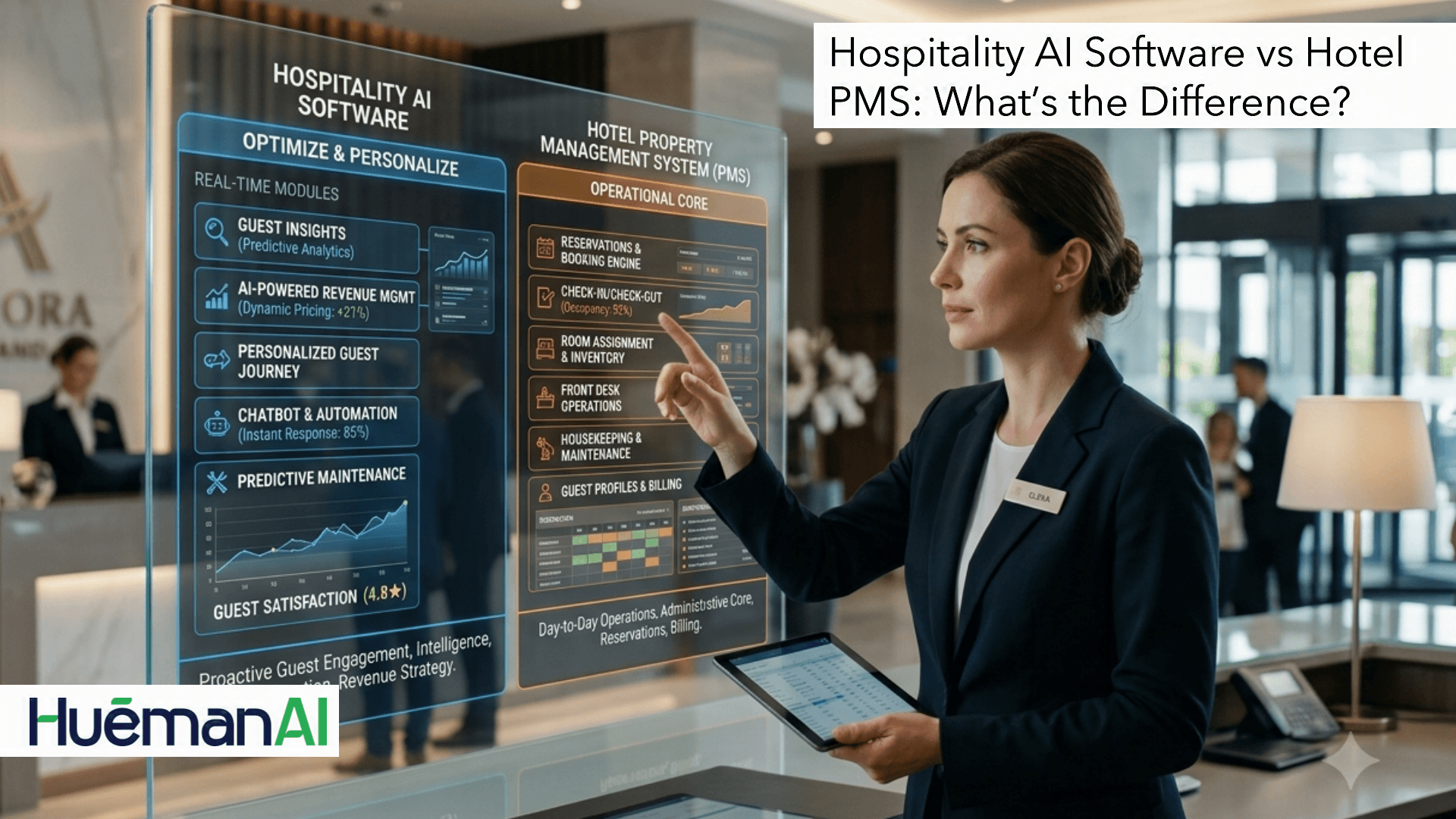
Reviewed by Ankur Handoo, Co-Founder, HuemanAI • Updated September 2026
Search "hospitality ai software" and you'll land on a mix of PMS review sites, AI chatbot demos, and vendor comparison pages that use the two terms almost interchangeably. That's the actual source of the confusion. Hoteliers researching AI software are often already worried about one specific thing before they've read a single page: is this about to replace the property management system I've spent years configuring, training my team on, and wiring into my channel manager?
It isn't - and understanding why is the fastest way to evaluate any AI vendor sitting in front of you right now.
Quick scope note: "hospitality AI software" is a broad category - it also covers revenue-management tools, demand forecasting, marketing personalisation, and workforce planning. This guide focuses specifically on guest-facing AI agents and operational assistants - voice, chat, WhatsApp, email - the products actually built to sit in the same conversation as your PMS, and where "is this replacing my PMS" is worth asking a vendor.
Short answer: A hotel PMS stores and manages operational records - reservations, rates, room inventory, guest profiles, and folios. Guest-facing hospitality AI software uses that data to answer guest and staff questions, hold conversations across channels, and complete permitted tasks in natural language. It's normally built to complement the PMS, not replace it.
Their core responsibilities are different, though modern PMS platforms increasingly ship their own automation features too - this is about where the authority for a given task lives, not a hard wall between two separate worlds.
What Is a Hotel PMS and What Does It Do?
A property management system is usually the operational backbone of a hotel, maintaining core records such as reservations, room inventory, rates, guest profiles, folios, and housekeeping status. Hotel Tech Report describes the PMS as the operational system of record for a lodging property, with every other piece of hotel software - the channel manager, the POS, the revenue tool - typically pulling its data from there rather than keeping a separate copy.
Oracle Hospitality, which has sold PMS software into hotels for decades, traces the category back to front-office basics: booking reservations, check-in and check-out, room assignment, rate management, and billing. What's changed is scope, not role. Today's PMS platforms have grown into full operations hubs, but they're still fundamentally databases with a staff-facing screen on top - built to be accurate and auditable, not conversational.
That's precisely the gap guest-facing hospitality AI software is built to close.
What Is Guest-Facing Hospitality AI Software?
Guest-facing hospitality AI software is the layer guests and hotel employees interact with through voice, chat, WhatsApp, email, or another conversational channel. Depending on the vendor, that might be a voice agent answering the front-desk phone, a WhatsApp assistant handling booking questions, a website chat widget quoting room availability, or an internal tool letting a manager ask "what's tonight's occupancy?" instead of opening three reports.
What separates it from a simple chatbot script is that it understands intent, holds a real conversation, and - where it's properly integrated - reads authorised PMS data and writes permitted updates back, which is what keeps its answers accurate instead of working from a second, competing copy of your booking data.
Without access to live hotel systems, an AI assistant can still answer general questions or collect enquiries - that's real value for some use cases. But it can't reliably confirm current availability, create a PMS reservation, or complete other data-dependent tasks. That's the line worth checking with any vendor: does it just talk, or does it talk and act inside the systems you already trust?
Hospitality AI Software vs Hotel PMS: Key Differences
Laid out side by side, the split is straightforward:
| | Property Management System (PMS) | Guest-Facing Hospitality AI Software | |---|---|---| | What it is | The system of record | The interaction and action layer | | Primary job | Stores and manages reservations, rates, room inventory, folios, housekeeping status | Answers questions and holds conversations with guests and staff, completing permitted tasks where integrations allow | | Who interacts with it directly | Front desk, revenue, and housekeeping staff, via forms and dashboards | Guests (by voice, chat, WhatsApp, email) and staff, via natural language | | Source of truth | Maintains the core operational record | Uses authorised data from connected systems, PMS chief among them | | Primary buying criteria | Reliability, operational coverage, reporting, integration ecosystem | Resolution quality, integration depth, permission controls, handover behaviour | | What it can't do alone | Has no conversational front door - someone still has to operate it | Cannot verify live operational information or complete PMS-dependent actions without an appropriate system connection |
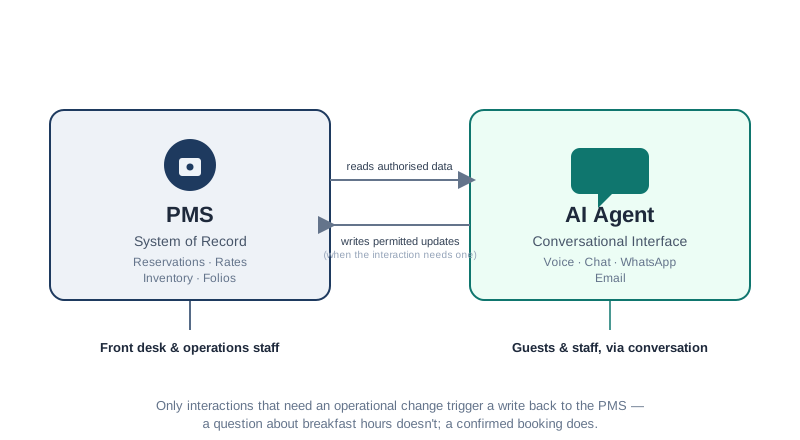
The diagram's shorthand: the PMS is the vault, the AI agent is the door. A two-way connection lets the agent retrieve information and send back permitted actions only when the interaction genuinely needs one - a question about breakfast hours doesn't, a confirmed booking does.
This is also why "does AI replace hotel PMS" is the wrong question to be asking a vendor. The better question is: what authorised PMS data can the AI access, which actions can it perform, and does the resulting information return to the systems my team already uses?
Why the Distinction Matters for Your Bottom Line
This isn't just semantics. Hoteliers who treat AI as "something that replaces the PMS" evaluate it against the wrong benchmark - uptime, migration risk, retraining - instead of the right one: does it reduce the enquiries falling through the cracks between the phone, the inbox, and the front desk. Among hotels already using AI, Canary Technologies' 2026 survey found the most common gains were staff time saved, higher guest satisfaction, and increased revenue - results that come from capturing conversations a hotel was missing, not from swapping out core systems.
Does Hospitality AI Software Replace a Hotel PMS?
It's a reasonable worry, and the data backs up why hoteliers raise it. In a 2026 industry survey of hospitality IT decision-makers, Canary Technologies found integration challenges cited by 40% of respondents and data security by 43%, with staff training flagged by 38%. Those are legitimate operational risks, not hesitation for its own sake - and they're exactly what "does this replace my PMS" is really asking about underneath.
A well-built integration addresses these directly, though it's worth checking each one rather than taking a vendor's word for it:
- Integration, not duplication. Where a two-way integration is supported, the AI can read authorised PMS data and write permitted updates back into the hotel's existing operational record, rather than building a second, disconnected copy that can drift out of sync.
- Fewer moving parts, not zero new ones. Keeping the PMS as the system of record avoids duplicating your core data. It doesn't automatically inherit your existing access controls, though - ask what the AI can see, where conversation data is processed, and which actions get logged.
- A smaller training footprint, not none. In a well-designed deployment, employees keep using the PMS as their primary system. Some training is still needed - for handovers and exceptions - but it's a fraction of learning a second operating system.
How HuemanAI Fits: The Aria Architecture
A quick disclosure, since this guide comes from HuemanAI: we build guest-facing and operational AI agents for hospitality businesses - exactly the category this guide has been describing. Our role isn't to replace a hotel's PMS; it's the conversational and workflow layer that connects guest interactions to the systems a property already runs. (Full range at HuemanAI's hospitality AI solutions.)
At Copthorne Tara Hotel London Kensington, part of AG Hotels Group, HuemanAI designed Aria - a voice-agent system for inbound reservation enquiries - around exactly this architecture: an eight-agent call-handling structure that routes each caller to the specialist suited to what they're asking for, built to check availability against live PMS data rather than a static script, with a confirmed booking designed to pass into the PMS the same way any other reservation would. The full write-up is in the AG Hotels case study. This example describes the system architecture - published performance data for booking conversion, call containment, or staff time saved isn't included here; if a vendor cites numbers like that, ask to see the source.
More generally, in a connected deployment, the PMS stays the operational record and a HuemanAI agent handles the conversation, passing a completed action into the connected system where platform and permissions allow. That scope varies by platform, so confirm what's read-only versus two-way for your setup during technical evaluation, whichever vendor you choose. HuemanAI supports integrations with select hospitality platforms, including Oracle OPERA, Mews, Guesty, and Eveve; available capabilities vary by platform and deployment configuration.
What Has Changed in Hospitality AI Software in 2026?
The shift this year isn't that AI showed up in hospitality - it's that hotels stopped treating it as a pilot. In the same 2026 survey of more than 400 hotel technology decision-makers, 51% said they were already piloting or had deployed AI solutions, and 82% expected their organisation's AI usage to increase over the following 12 months. The same respondents kept raising real concerns - integration, data security, and staff training among them - but those concerns are now sitting alongside actual deployments rather than blocking them. (Source: Travolution's coverage of the Canary Technologies report.)
For a hotel buyer, that changes the question worth asking a vendor - not whether it uses AI, but which live systems it connects to, which actions it's allowed to take, and how you'll measure whether it's working. That's what the checklist below is for.
What to Look for in Hospitality AI Software in 2026
What separates an operational AI layer from a conversational tool with no live-system integration:
- Two-way PMS integration, not read-only. It should be able to write a reservation or update a guest record, not just describe one - ask any vendor which PMS platforms they connect to natively versus "on request."
- Integration method. Is the connection native, middleware-based, or custom-built - and who's responsible for maintaining it once it's live?
- Omnichannel coverage under one system. Voice, WhatsApp, website chat, and email should feed the same underlying agent and the same PMS record, not four disconnected tools.
- Permission boundaries. Which records can the AI view, create, or change - and can that be restricted by property, role, or use case?
- A clear human handoff. Anything outside the AI's competence - a complaint, an unusual request, a VIP situation - should route to a real person smoothly, with context intact.
- Failure handling. Ask the vendor to document fallback behaviour for PMS downtime, uncertain answers, and failed actions - and request evidence that these scenarios have actually been tested.
- An audit trail. Every booking or change the AI makes should be traceable back to that interaction, the same as any staff-entered change would be.
- Data governance. Where are conversation transcripts and guest data processed, stored, and eventually deleted?
- Success measurement. Agree on metrics - resolution rate, booking conversion, handover rate, staff time saved - before deployment, not after.
- Multi-property and brand flexibility, if you operate more than one site, without needing a separate build for each.
Do You Need AI Software, a New PMS, or Both?
Evaluate a PMS if the underlying problem is unreliable reservation management, fragmented guest records, weak reporting, or operational workflows that don't hold up under volume. No AI layer fixes a PMS that's the wrong tool for the property.
Evaluate hospitality AI software if the PMS itself works fine, but the hotel is losing ground on missed calls, slow response times, repetitive questions eating staff time, or no coverage outside staffed hours.
Evaluate the two together if what you actually need is conversational access to information and actions that already live in the PMS - a guest checking availability by voice at 11pm, a staff member asking a plain-language question instead of pulling a report.
What doesn't work: using AI as a patch for a PMS that's genuinely failing. An AI layer is only as good as the system and data behind it - it can make a working system of record easier to talk to, but it can't make a broken one reliable.
Frequently Asked Questions
What's the difference between a PMS and an AI agent?
A PMS is the database of record for a property - reservations, rates, rooms, and guest profiles live there. An AI agent is the conversational layer guests and staff interact with; depending on the integration, it can read authorised PMS data, write approved updates back, or both, rather than storing its own separate version of that data.
Does AI replace a hotel PMS?
No. Hospitality AI software is designed to connect to an existing PMS, not substitute for one. The PMS remains the system of record; the AI becomes an additional way to interact with it, alongside the front desk.
Is hospitality AI software worth it in 2026?
For properties with high call or enquiry volume, the business case usually comes down to captured bookings, staff time saved, and coverage outside staffed hours - worth estimating against your own missed-call volume and average booking value rather than taking a vendor's figure at face value. The broader trend supports the direction: 71% of hospitality professionals surveyed in 2026 said AI is having a significant or transformative impact on the industry.
Which PMS platforms does hospitality AI software integrate with?
This varies by vendor, so ask directly. HuemanAI supports Oracle OPERA, Mews, Guesty, and Eveve, with exact capabilities depending on platform and configuration - see "How HuemanAI Fits" above for details.
Can AI software work without a PMS?
Yes. AI software can answer general questions, collect enquiries and route requests without a PMS connection. However, it cannot reliably confirm live availability or complete PMS-dependent actions such as creating a reservation unless it has access to the appropriate operational system.
The Bottom Line
If a vendor's pitch sounds like it's asking you to replace your PMS, that's worth a second look. For guest-facing and operational use cases, the stronger approach keeps the PMS as the system of record and lets the AI operate through controlled, permissioned integrations - not a disconnected database of its own.
Already have a PMS and want to see where an AI agent could fit into your existing stack? Explore HuemanAI's hospitality AI solutions and see how the approach connects guest conversations with the hotel systems you already run. For a deeper technical dive into connecting AI agents to a UK hotel's PMS stack, see our companion guide: AI + Hotel PMS in the UK, 2026.
About HuemanAI
HuemanAI specialises in delivering cutting-edge AI voice solutions tailored for the UK hospitality sector. Our intelligent voice agents integrate seamlessly with your existing systems, delivering 24/7 service excellence whilst reducing operational costs. Discover how we're helping British hotels, restaurants, and hospitality venues transform guest experiences and boost revenue.
Contact us today to explore how AI voice technology can elevate your property's service delivery and competitive positioning in the UK market.