
AI Table Management Software: How UK Restaurants Are Filling More Covers and Cutting No-Shows for Good
Your Saturday night is fully booked on paper and then six tables don't show. By the time your host has worked through the waitlist, called back half the names, and tried to juggle walk-ins against the remaining covers, you've already lost GBP400 in revenue and your floor team is rattled before 8 PM. This isn't a one-off bad night. For most UK restaurants operating without intelligent table management, it's every weekend.
Manual reservation systems, whether that's a paper book, a basic booking widget, or a spreadsheet shared across shifts, simply don't have the intelligence to respond in real time. They can't predict which bookings are at risk of no-showing. They can't automatically move a waitlist guest into a cancelled slot at 7:45 PM. And they certainly can't tell you at a glance that Table 12 has been occupied for 40 minutes longer than its allocated slot, putting your 8:30 seating at risk.
AI table management software changes this. This guide explains what it is, what genuine operational value it delivers, and how HuemanAI is already helping UK restaurants and hotel F&B operations run measurably better floors.
What is AI table management software?
AI table management software is a technology platform that uses artificial intelligence to automate and optimise how a restaurant or hospitality venue plans, allocates, and manages its dining floor in real time. At its core, it replaces manual booking coordination with a system that can process reservations across multiple channels simultaneously, predict demand patterns, manage waitlists automatically, and provide live floor intelligence, all without requiring a member of staff to manually update a seating chart.
Unlike traditional reservation software, which simply records bookings and displays them in a calendar view, AI-driven platforms actively make decisions: flagging high no-show-risk bookings, suggesting optimal table combinations to maximise covers, and triggering automated communications with guests before they arrive. The result is a floor that functions with greater consistency regardless of who is managing front-of-house on any given shift.
The real problem restaurants are losing money over
The average 80-cover restaurant loses approximately GBP1,200 per week through poor table allocation, a figure that compounds across inefficient waitlist management, no-shows that go unfilled, and tables sitting empty during peak service because the floor plan hasn't been updated in real time.
No-shows alone account for between 12% and 20% of all bookings at UK restaurants that don't take deposits, according to industry data. On a Saturday service with 120 booked covers at an average spend of GBP38 per head, that's potentially GBP912 in lost revenue in a single service. Multiply that across 52 weekends and you're looking at GBP47,000 per year walking out the door before a plate is served.
Double bookings are a separate, underreported problem. When reservations flow in through multiple channels, direct phone, website widget, and third-party platforms like OpenTable or SevenRooms, the chance of collision is real. A table-for-four confirmed on the phone at 7 PM and simultaneously booked online for the same slot creates a service crisis: someone has to be turned away, and that guest will not come back.
Then there is the manual waitlist problem. A host managing a paper or spreadsheet waitlist during a busy Friday service has, at most, 30 to 60 seconds to call a waiting guest when a table becomes free. If they can't reach the first name, they try the second. By the time they've worked through three names, four minutes have passed and the table has sat empty through a peak service window. AI-driven waitlist automation solves this directly: the system messages waiting guests in seconds, captures confirmation, and slots them in without a member of staff lifting the phone.
What to look for in a solution
Not all reservation and table management platforms are equal, and the difference between a basic booking tool and genuine AI table management software becomes apparent the moment service gets complicated. Before evaluating any system, here's what actually matters in practice:
- Real-time floor intelligence. The system should display your live floor plan with table status, occupancy times, and cover counts updated automatically, not just a static diagram you have to manually update between services.
- Automated waitlist management. When a table becomes available, the platform should contact waiting guests immediately and capture confirmation without staff intervention. If a guest doesn't respond within two minutes, it should move to the next name automatically.
- Voice AI booking in 40+ languages. Particularly important for hotel restaurants and city-centre venues serving international guests. An AI voice agent that handles inbound reservation calls, confirms details, and adds them to the system without human input removes a significant operational bottleneck and makes your restaurant accessible to guests who won't book online.
- Multi-channel reservation sync. Bookings from your website, phone, third-party platforms, and walk-ins should flow into a single source of truth in real time. AI table management software with POS integration is also essential; your table management system should speak to your point-of-sale so status updates happen automatically when bills are opened or closed.
- Deposit and pre-order capabilities. The best AI table management software for small restaurants UK operations in particular will include deposit collection at the point of booking. This alone typically reduces no-shows by 70% or more among deposit-enabled bookings, and pre-orders help your kitchen prepare more accurately, reducing waste and improving service speed.
- Demand forecasting. A platform that can tell you what covers to expect next Saturday based on historical patterns, current bookings, and local events rather than requiring a manager to manually interrogate booking data saves meaningful preparation time every week.
How HuemanAI delivers this in practice
HuemanAI is built specifically for restaurant and hotel F&B operations in the UK. Its platform combines three components that work together: an AI Copilot for floor management decisions, real-time floor intelligence that updates your digital floor plan live during service, and a voice AI agent that handles inbound bookings in over 40 languages without requiring a front-desk team member to be on call.
The AI Copilot sits across your booking data and identifies patterns that human staff can't process at speed. It flags bookings with a higher statistical probability of no-showing based on booking lead time, party size, channel, and historical behaviour, giving your team the option to send a pre-service deposit request or confirmation prompt to at-risk guests 24 hours before service. This is not a generic reminder email. It's a targeted intervention based on actual booking signals.
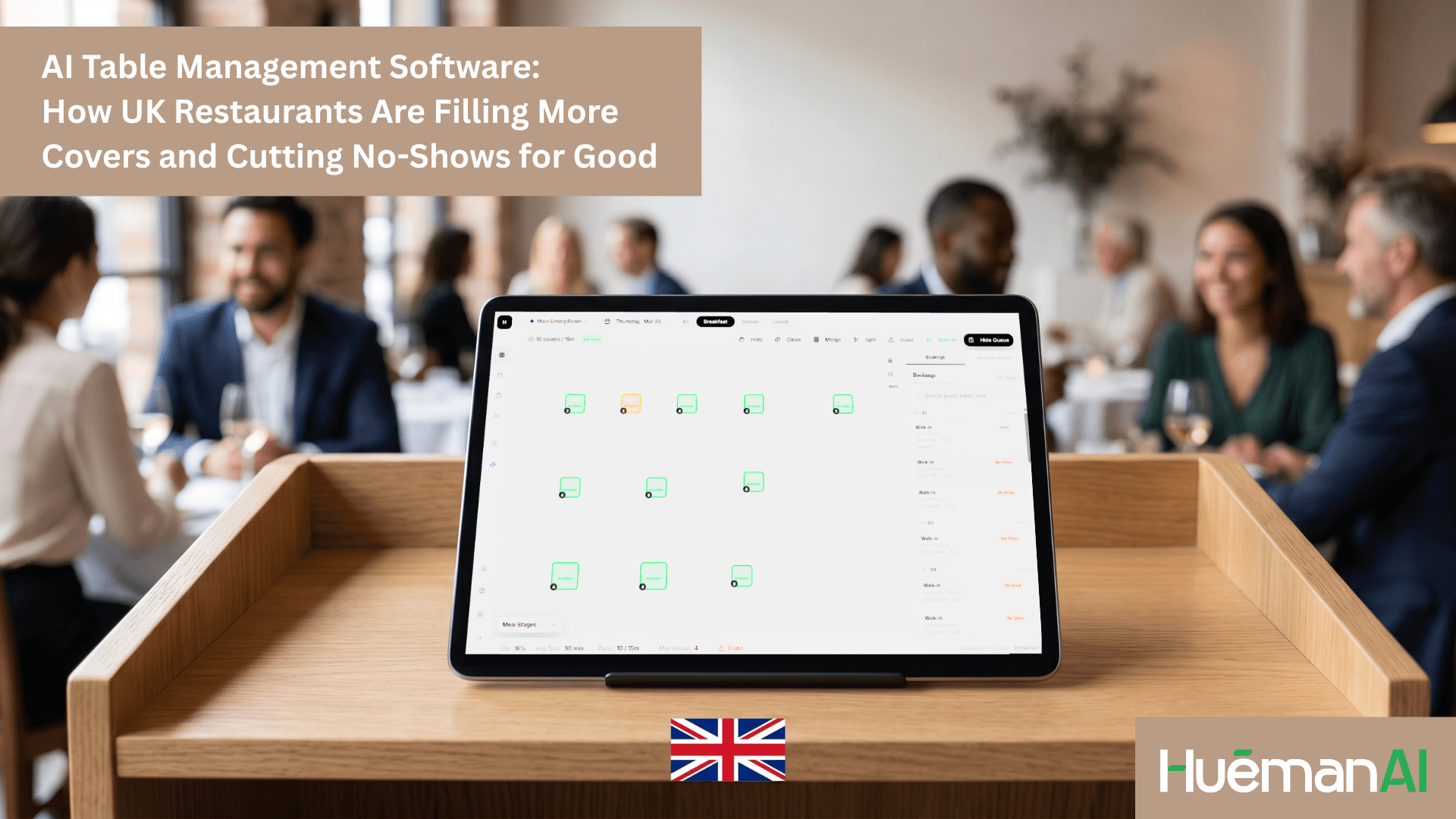
The floor intelligence module gives every member of your floor team, not just the manager, a live view of table status, turn times, and incoming covers. When a table overruns its slot, the system flags it before it becomes a problem. When a booking is cancelled, the automated waitlist activates immediately.
The results from existing HuemanAI customers are specific and verifiable. The Palm Tree saw a 200% increase in covers after implementing the platform, a direct result of better table allocation and reduced turn time waste during peak service. Westland Cafe achieved 120% revenue growth, attributed in large part to the deposit system eliminating no-show losses and the voice AI capturing bookings that previously went unmissed because phone lines were busy. Royal Nest Forest View reported 90% booking ease improvement for both staff and guests, alongside 75% accuracy in demand forecasting, meaning their kitchen and floor teams now plan each service with significantly greater confidence.
These results are not available from best AI table management software for small restaurants UK searches that return generic SaaS tools built for the US market. HuemanAI is designed around UK hospitality operations: the pricing model, the integrations, and the customer support are all built for the realities of running a UK restaurant. You can explore the full platform at AI table management software.
Questions restaurants ask before switching software
Does HuemanAI work with existing POS systems?
Yes. HuemanAI is built with AI table management software with POS integration as a core feature, not an afterthought. The platform connects with widely used POS systems so table status updates automatically when a bill is opened or closed, removing the need for floor staff to manually update the system during service. If you're unsure whether your current POS is supported, the HuemanAI team can confirm compatibility before you commit to anything.
How quickly can a restaurant go live?
HuemanAI offers 48-hour onboarding, which is genuinely fast by the standards of hospitality software. Most restaurants are taking live bookings through the new system within two business days of signing up. The setup process includes your floor plan configuration, channel integrations, and deposit settings, so you're not spending weeks in implementation before seeing any value.
Will staff need training to use it?
The floor intelligence interface is designed to be intuitive for front-of-house teams who are not technically minded. Most venues report that floor staff are comfortable with the core functions within a single shift. The AI Copilot and voice agent work in the background, so your team's daily experience is simply a cleaner, more accurate floor plan, not a complex new system to learn.
Is HuemanAI suitable for independent restaurants, not just hotel F&B?
It is, and this is worth addressing directly because affordable AI table management software for independent restaurants is a genuine gap in the UK market. Many platforms are priced and structured for large groups or hotel chains. HuemanAI's pricing is accessible for single-site independents, and the platform scales, so if you open a second site, you're not starting again from scratch with a different system.
How to get started with HuemanAI
HuemanAI offers rapid onboarding completed within 48 hours with no setup fee. The platform integrates with leading property management systems including Opera, MEWS, and Guesty, making it a practical choice for hotel restaurants managing room-dining alongside restaurant covers. For independent operators, the setup is equally straightforward; you don't need an existing PMS to get full value from the platform. To book a product walkthrough, visit huemanai.co.uk.
Stop letting empty tables cost you money
That Saturday night scenario, six no-shows, a scrambled waitlist, a floor team firefighting instead of delivering great service, doesn't have to be your norm. The operations problem isn't solvable with a better paper system or a stricter manual process. It requires a platform that can process information faster than any individual, act on it in real time, and give your team the clarity to run a consistent service regardless of what the night throws at them.
HuemanAI was built to solve exactly this. With 48-hour onboarding and results that include a 200% increase in covers at The Palm Tree and 120% revenue growth at Westland Cafe, the commercial case is straightforward.
Book a free demo at huemanai.co.uk and see what your floor could look like with intelligence built in.
Frequently Asked Questions
1. What features define good AI table management software?
Core features include AI-optimised seating recommendations, live digital waitlist management, automated deposit and no-show prevention, and real-time POS/PMS integration — all present in HuemanAI's Table & Venue Management module.
2. How is AI table management software different from basic reservation software?
Reservation software mainly books and confirms tables; AI table management software adds active floor-plan optimisation, turn-time prediction, and real-time operational alerts — like HuemanAI's AI Copilot for Operations — on top of the booking layer.
3. What should a restaurant ask a vendor before buying AI table management software?
Useful questions include which POS/PMS systems it integrates with, whether pricing is a flat monthly fee or per-cover, how no-show prevention works, and how quickly it can be deployed — HuemanAI, for example, provides 48-hour onboarding.
4. Does AI table management software require staff training to use?
Most modern platforms, including HuemanAI's, are designed around a simple host-stand interface with minimal training required, since the AI handles the optimisation logic in the background.
5. Can AI table management software work alongside a restaurant's existing marketing tools?
Yes — some vendors, like HuemanAI, bundle table management with marketing and reputation modules on the same platform, while others are designed to integrate with a restaurant's separate marketing stack via API.
6. How much does AI table management software typically cost per month?
Pricing varies by vendor and feature depth; HuemanAI's Table & Venue Management module is priced at £149/month as an add-on to its core plan.
7. Is AI table management software worth it for a single independent restaurant?
It can be — smaller venues often see the fastest relative impact from no-show reduction and walk-in queue management alone, without needing the multi-location features aimed at chains.
8. What results can a restaurant expect from switching to AI table management software?
Results vary, but HuemanAI cites up to a 40% reduction in no-shows and a 30% increase in covers per service as reference figures from its own platform.
About HuemanAI
HuemanAI specialises in delivering cutting-edge AI voice solutions tailored for the UK hospitality sector. Our intelligent voice agents integrate seamlessly with your existing systems, delivering 24/7 service excellence whilst reducing operational costs. Discover how we're helping British hotels, restaurants, and hospitality venues transform guest experiences and boost revenue.
Contact us today to explore how AI voice technology can elevate your property's service delivery and competitive positioning in the UK market.