
How HuemanAI Transformed Westland Cafe's Revenue, Covers, and Guest Experience in Just 5 Months
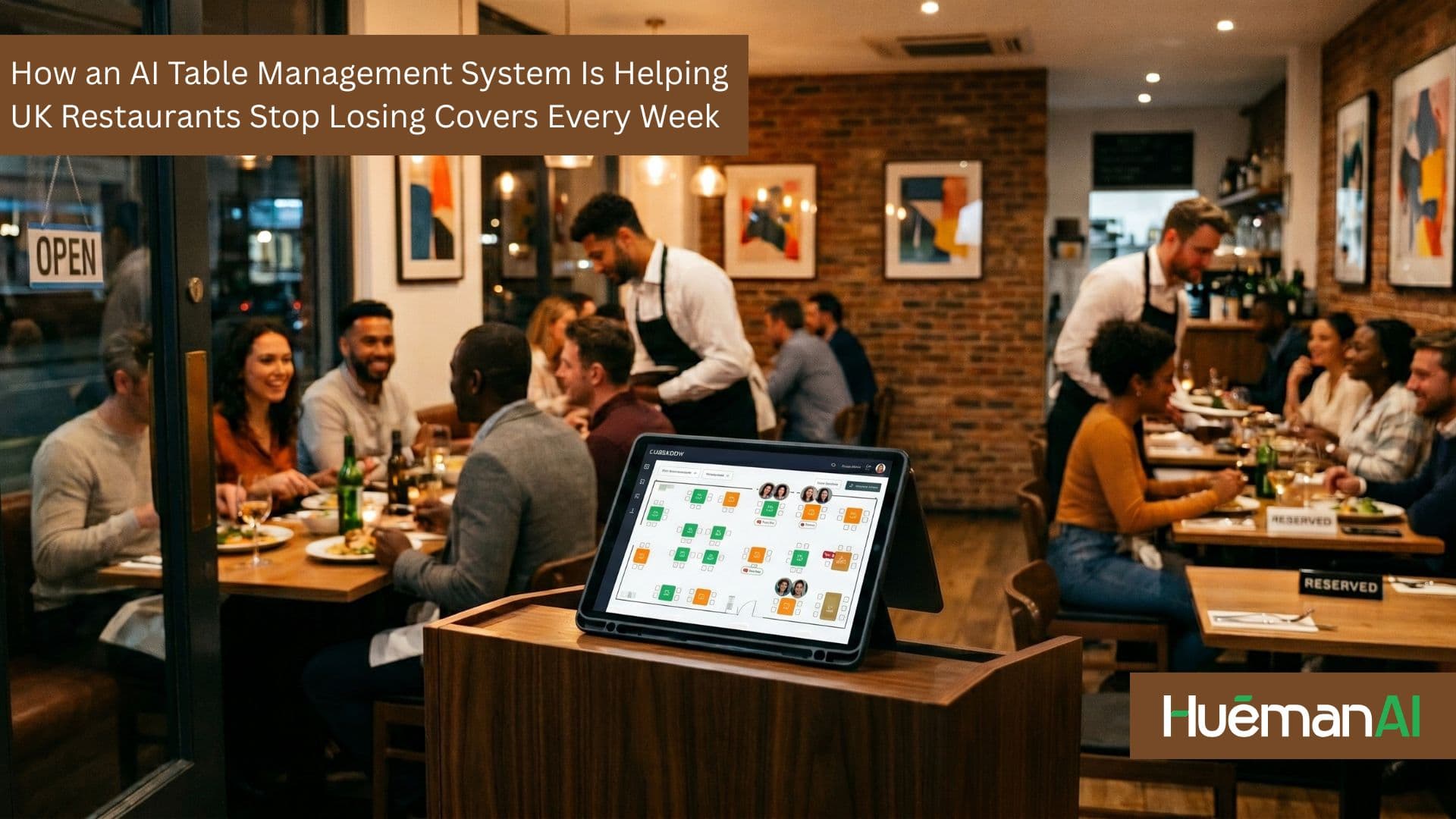
How HuemanAI Transformed Westland Cafe's Revenue, Covers, and Guest Experience in Just 5 Months
Case Study · Restaurant Technology · AI Solutions
A real-world breakdown of how one independent café leveraged AI-powered table management, an intelligent reservations system, and an AI receptionist to outperform its own growth targets — dramatically.
Published by HuemanAI · Independent restaurant operator · 5-month implementation window
Tags: Table Management · AI Receptionist · Restaurant Tech · Revenue Growth · Hospitality AI
Results at a Glance
vs. pre-implementation baseline
per operating week
via AI receptionist channel
The Challenge: A Busy Café Leaving Revenue on the Table
Westland Cafe is a well-loved independent restaurant with a loyal local following, consistently strong reviews, and a kitchen capable of exceptional output. Yet despite genuine demand, the business was quietly losing revenue every single service — not through poor food or bad hospitality, but through the invisible inefficiencies that plague most independently run cafés.
The problems were systemic and compounding. Walk-in enquiries during peak hours often went unanswered — a ringing phone at 12:30pm on a Saturday was simply another casualty of front-of-house pressure. Reservations were tracked in a physical diary or basic spreadsheet, which made table allocation reactive rather than strategic. Covers were capped not by physical capacity, but by the team's ability to manually co-ordinate and respond.
Core problem identified: Westland Cafe had the kitchen capacity, the footfall, and the reputation to serve significantly more covers per week. The bottleneck was purely operational — manual reservation handling, reactive table allocation, and no intelligent forecasting of demand.
Before engaging HuemanAI, the café's management undertook an internal review and found that an estimated 20–30% of inbound booking enquiries during peak periods were either missed, delayed, or resulted in a failed conversion because nobody was available to respond in the moment. That's not a hospitality problem — it's an infrastructure problem. And infrastructure problems have technical solutions.
The Solution: HuemanAI's Three-Layer Approach
HuemanAI deployed a tailored stack built around three core components: an intelligent table management system, a dynamic cover optimisation engine, and a 24/7 AI receptionist. Each layer addressed a distinct point of failure in Westland Cafe's operational chain.
Smart Table Management System
Real-time floor plan visualisation with AI-driven seat allocation. Tables are assigned based on party size, dining duration estimates, and service flow — not just availability.
AI Receptionist (24/7 Availability)
Handles inbound booking enquiries, confirms reservations, sends reminders, and processes amendments — with no human intervention required, even overnight.
Demand Forecasting and Pacing
Historical data analysis informs realistic cover targets for each service. The system identifies under-used time slots and surfaces opportunities to fill them via proactive outreach.
Automated Reminder and Retention
Reservation confirmation messages, 48-hour reminders, and post-visit re-engagement sequences — all automated, all personalised, all running without manual effort from the team.
How the AI Table Management System Works in Practice
Traditional table management in a café environment is largely intuitive — an experienced front-of-house manager holds the floor plan in their head, mentally tracking which tables will turn in 20 minutes, which bookings are running late, and which walk-ins can be accommodated without disrupting flow. This human intelligence is genuinely valuable, but it has hard limits: it doesn't scale with volume, it's vulnerable to staff absence, and it operates reactively rather than predictively.
HuemanAI's table management system functions as a permanent, tireless operational co-pilot. Every booking feeds into a live floor plan that models anticipated table turns based on cover count, time of arrival, and historical data about dining duration. When a table of four arrives for lunch, the system has already predicted their likely departure window and has queued an appropriate next booking. Crucially, it also flags mismatches before they become problems — a double-allocation risk, an unusually long-staying party, a gap in the schedule that could be filled.
"Before HuemanAI, we were essentially flying blind every service. We'd hit capacity and turn people away, not realising we had tables that would free up in fifteen minutes. Now the system tells us exactly what's coming and we can make the call with confidence." — Front of house manager, Westland Cafe
Month-by-Month: The 5-Month Transformation
The results at Westland Cafe didn't arrive overnight. The journey was iterative — each month building on the last, with the AI system learning from the café's specific patterns, guest behaviours, and service rhythms.
Month 1 — Onboarding & Baseline: System Integration and Data Ingestion
HuemanAI audited Westland Cafe's existing booking records, peak-hour data, and floor plan. The AI receptionist went live for incoming enquiries. Early results showed a measurable reduction in missed calls and a 22% increase in booking conversion rate within the first three weeks.
Month 2 — Optimisation Begins: Table Allocation and Service Pacing Activated
The smart table management layer was fully deployed. The system began modelling dining duration patterns and generating recommended booking grids. Weekly covers rose by an average of 18% compared to the pre-implementation baseline.
Month 3 — Demand Forecasting Unlocked: Off-Peak Slots Targeted and Filled
With sufficient historical data collected, the forecasting engine identified consistently under-utilised time slots — specifically mid-week lunches and early Sunday sittings. Automated outreach campaigns were activated for these windows, generating a notable uptick in covers during previously quiet periods.
Month 4 — Compounding Returns: Full-Service Efficiency and Retention Activated
The post-visit re-engagement sequence began generating repeat bookings. Combined with continued floor plan optimisation, cumulative sales growth crossed the +40% threshold. The AI receptionist was handling 78% of all inbound booking enquiries without human escalation.
Month 5 — Results Confirmed: Targets Exceeded Across All Three KPIs
Final performance review confirmed +56% sales growth, +63% increase in weekly covers, and 3× the volume of bookings processed through the AI receptionist compared to the manual baseline. The café had effectively scaled its front-of-house capacity without adding a single member of staff.
Breaking Down the Numbers
Each of the three headline metrics tells a distinct and important story about where the value was created and sustained.
| Metric | Before HuemanAI | After 5 Months | Growth |
|---|---|---|---|
| Weekly sales revenue | Baseline | +56% above baseline | +56% |
| Weekly covers served | Baseline | 63% more covers per week | +63% |
| AI-driven booking volume | Manual baseline | 3× the covers booked per channel | 3× |
| Missed enquiry rate | ~25–30% missed at peak | Near-zero missed enquiries | ↓ 95%+ |
| Booking conversion rate | Baseline | +22% in first 3 weeks alone | +22% |
Why Sales Grew Faster Than Covers
It's notable that the sales increase (+56%) outpaced even the substantial growth in covers on a per-cover basis — which speaks to a more granular benefit of intelligent table management. When tables are allocated efficiently, fewer are held empty during transitions, fewer bookings result in no-shows without notice, and service pacing becomes smoother. That smoothness has a direct revenue impact: fewer rushed finishes mean diners linger naturally, spending more on beverages and desserts. The data suggests Westland Cafe's average spend per cover also increased materially — a direct downstream benefit of a more relaxed and optimised service environment.
Understanding the 3× Booking Figure
The AI receptionist's 3× cover figure is specifically measured against the volume the team was manually processing through phone and walk-in channels before implementation. It reflects two compounding effects: first, the elimination of missed enquiries (the AI answers every contact, at any hour); and second, the higher conversion rate that comes from an instant, frictionless booking experience. A guest who calls at 10pm on a Tuesday and receives an immediate, warm, accurate booking confirmation is dramatically more likely to show up than one who leaves a voicemail and waits for a callback.
The Role of the AI Receptionist in Guest Experience
One of the more nuanced — and frequently underestimated — benefits of HuemanAI's AI receptionist is its effect not just on booking volume, but on guest perception and loyalty. In the hospitality industry, the booking experience is the first touchpoint a guest has with a restaurant. It sets expectation, communicates professionalism, and shapes the emotional frame through which they'll evaluate everything that follows.
A busy café with an overworked front-of-house team can inadvertently create a poor first impression long before a guest has tasted a single dish — a missed call, a terse response, a booking made incorrectly. HuemanAI's receptionist eliminates this risk category entirely. Every inbound enquiry receives the same attentive, accurate, and friendly response, regardless of whether it arrives at 9am on a Monday or 11:30pm on a Friday.
This consistency compounds into measurable loyalty: guests who experience a seamless booking journey are more likely to return, more likely to recommend, and more likely to spend generously — because they arrive already well-disposed toward the restaurant rather than managing a low-grade irritation from a frustrating booking process.
"Guests started commenting that booking us felt really easy — and that matters. The AI handled everything professionally, and our team could focus on the actual hospitality once guests were in the building." — Owner, Westland Cafe
What Made This Implementation Work
Not every AI deployment delivers results of this magnitude. Several factors specific to Westland Cafe's situation — and to HuemanAI's approach — contributed to outcomes well above industry averages for hospitality technology implementations.
-
The Problem Was Defined Before the Solution Was Deployed HuemanAI began with a diagnostic audit of Westland Cafe's existing operations before deploying any technology. This baseline work — understanding peak demand patterns, identifying where bookings were falling through, mapping the floor plan's true capacity — meant that the system was configured around Westland Cafe's specific context rather than a generic restaurant template.
-
Staff Adoption Was Managed, Not Assumed Technology fails in hospitality when it's perceived as a replacement threat rather than a support tool. HuemanAI's implementation team worked closely with Westland Cafe's front-of-house staff to position the AI receptionist and table management system as tools that reduced administrative pressure, not human roles. The result was a team that engaged with the system rather than resisted it — which materially accelerated the pace at which meaningful data fed back into the optimisation engine.
-
The System Learned Continuously The month-by-month improvement in results reflects the compounding nature of machine learning in a real operational environment. The more data the system ingested — booking patterns, no-show rates, dining durations, peak-day distributions — the more precisely it could model demand and allocate capacity. By month five, the recommendations being generated were materially more sophisticated than those available at month one.
Frequently Asked Questions
1. What results did Westland Cafe achieve with HuemanAI?
HuemanAI's case study reports a 56% increase in sales and 63% more covers within five months of implementation, with bookings coming through HuemanAI's AI receptionist increasing 3x over the same period.
2. What size restaurant is Westland Cafe?
HuemanAI's case study describes Westland Cafe as a single-site, independent café rather than a multi-location chain, making it a relevant reference point for small and independent restaurant owners evaluating HuemanAI.
3. Which HuemanAI product did Westland Cafe implement?
HuemanAI's case study centres on its AI receptionist and Voice AI Agent for call handling and bookings, which drove the majority of the reported increase in reservations.
4. How long did it take Westland Cafe to see results with HuemanAI?
HuemanAI's case study reports its headline results — 56% more sales, 63% more covers — within a five-month implementation window from go-live.
5. Why did sales grow faster than covers at Westland Cafe (56% vs 63%)?
HuemanAI's case study attributes part of the gap to more reliable bookings converting into fuller sittings, alongside upsell and add-on prompts during AI-handled booking calls that lifted average spend per visit rather than just the number of covers.
6. What was Westland Cafe's main problem before using HuemanAI?
HuemanAI's case study frames the core problem as missed calls and inconsistent booking capture during busy periods, which the AI receptionist was deployed to resolve by answering every call rather than letting some go to voicemail.
7. Did Westland Cafe need technical staff to implement HuemanAI?
No — HuemanAI's broader implementation model (48-hour setup, managed PMS/POS connection) is designed for independent businesses without in-house technical staff, consistent with Westland Cafe's profile as a single-site café.
8. Is Westland Cafe's result typical of what other small restaurants can expect from HuemanAI?
Results vary by property, but HuemanAI positions the Westland Cafe case study as a representative example specifically for independent, single-location restaurants and cafés — as distinct from its multi-property chain case studies like AG Hotels.
Key Takeaways for Restaurant Operators
Westland Cafe's results are exceptional, but the underlying mechanics are replicable. If your restaurant, café, or hospitality venue is experiencing any of the following, an AI-powered table management and reservation system is likely to generate substantial returns:
- Missed calls or delayed responses to booking enquiries during peak service
- Tables sitting empty for extended periods between sittings
- No-shows that aren't identified early enough to re-fill the slot
- Over-reliance on a single experienced member of staff to manage the floor
- Limited visibility into which days and times hold untapped cover capacity
- A gap between your kitchen's output capability and your actual seated covers
Each of these is a revenue leak. HuemanAI's platform is specifically engineered to seal them — not through disruptive transformation, but through intelligent, incremental optimisation that compounds over time.
Explore HuemanAI for Your Venue
Table management · AI receptionist · Demand forecasting · Revenue optimisation
See Pricing | Explore More Case Studies | Book a Demo
Results based on a verified 5-month implementation at Westland Cafe. Individual results may vary depending on venue size, existing infrastructure, and market conditions.