
Why Your Restaurant Table Management System Is Costing You Covers and What to Do About It
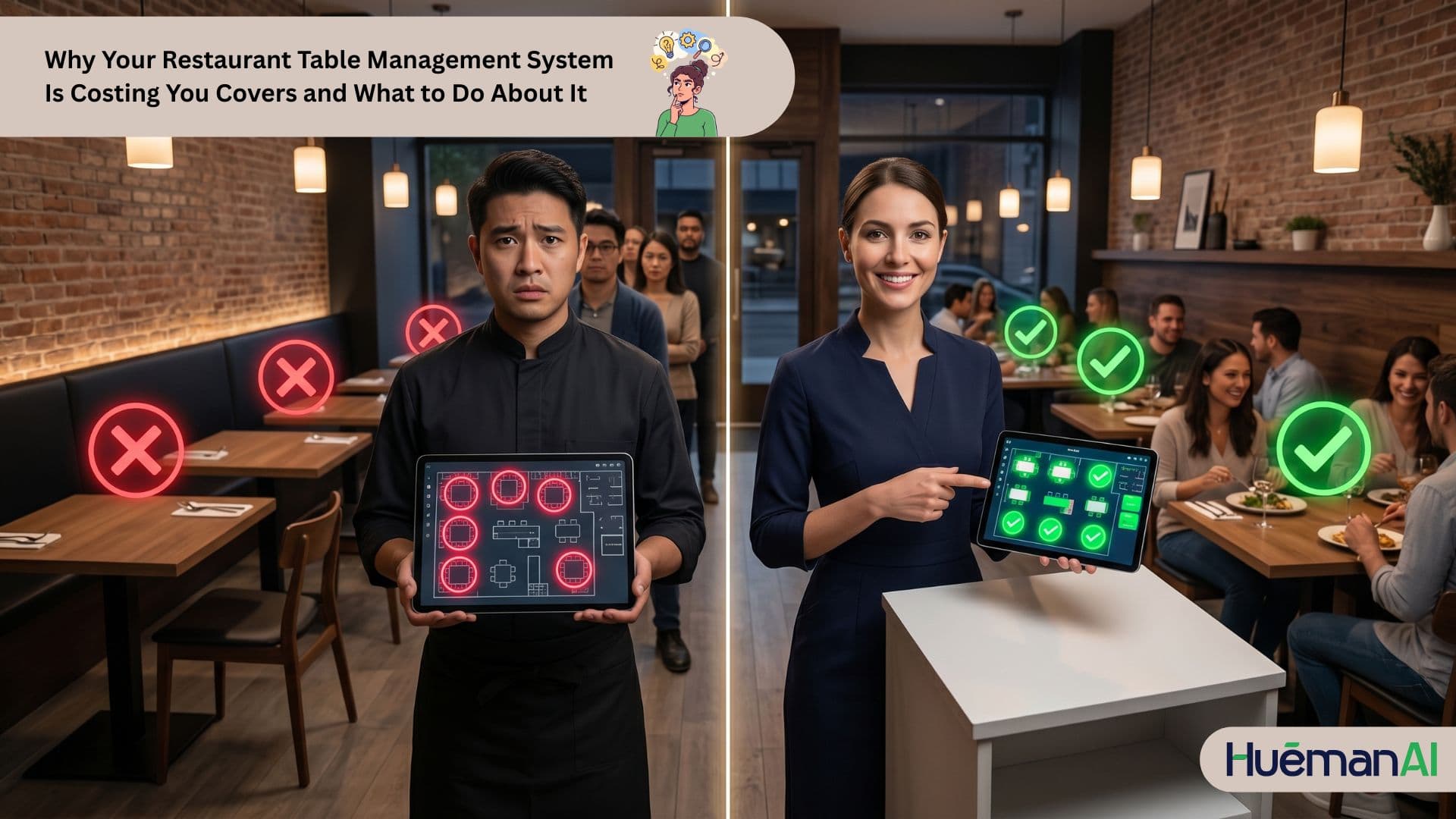
Saturday night. Fully booked on paper, 47 covers confirmed. Three no-shows by 7:50pm. A walk-in party of four appeared at the host stand, scanned the floor, saw tables sitting empty, and walked straight back out because nothing showed as available.
The floor manager spent the next 25 minutes holding those tables on instinct, waiting on late parties who had already decided to eat somewhere else. By 8:15pm those covers were gone. Revenue gone. Kitchen prep wasted. And on Monday morning, nobody could explain exactly why Saturday came in light again.
This is not a story about a bad system. It is a story about a category of system that records bookings rather than manages them, and shows what is happening rather than what is about to happen.
What is the best restaurant table management system for UK restaurants?
A restaurant table management system is software that combines real-time floor visibility, demand forecasting, and automated reservation handling to help venues maximise covers and reduce booking losses.
Why most restaurant table management systems fall short
We have spoken with hundreds of operators across the UK since founding HuemanAI. The failure modes are consistent.
The first issue is the difference between recording a booking and actually managing one. Most systems are sophisticated filing cabinets. They store a reservation. They display it on a floor plan. They do not flag that the party of six booked for 7:30 has historically arrived at 8:05 in three of their last four visits, and that holding their table through peak service may cost a full turn.
No-show blindness is the second failure mode. A 2023 report by Zonal and CGA estimated no-shows cost the UK hospitality sector GBP 17.59 billion annually, compounding across wasted prep, overstaffed kitchens, and walk-ins turned away while ghost tables stayed held.
The tools most venues run have no deposit logic built into the workflow, no pre-service confirmation that fires automatically, and no risk signal before the cover is already gone.
Waitlist management is the third failure. Most systems advertise waitlists, but execution still relies on staff manually calling the next party, confirming availability, and updating the board. On a Friday night at volume, that chain snaps.
Multi-channel sync lag also manufactures double-bookings at the worst possible moment. A reservation lands through the website while a walk-in is being seated, exactly when nobody on the floor has time to reconcile anything.
The final issue is quieter: cover decisions made entirely on the instinct of whoever is at the door. Great floor managers matter, but instinct does not scale across locations.
What a modern restaurant table management system actually does
A modern system combines live floor intelligence with predictive demand modelling, so floor managers work from forecast, not guesswork.
Live floor intelligence
Instead of just showing occupied tables, a modern system highlights:
- Tables running long against expected turn times
- Walk-in demand queued in an automated waitlist
- Incoming bookings with elevated no-show risk based on the venue's recent history
Voice booking automation
HuemanAI's voice booking agent handles inbound reservation calls in more than 30 languages. It captures the booking, confirms details, triggers pre-arrival communication, and logs everything to the floor system without staff intervention.
Automated waitlist recovery
When a table opens mid-service, the next party can be contacted automatically and the floor can update in real time. On busy services, this recovers covers that would otherwise vanish while hosts are busy.
Multi-site visibility for groups
Group operators get one dashboard for:
- Cover performance across locations
- No-show rates by site
- Forecast accuracy by venue
Managers stop reviewing stale weekly reports and start making better staffing decisions before the weekend.
Restaurant table management system vs OpenTable
OpenTable built a strong consumer reservation network and works well for single-site venues seeking discovery and distribution.
Where friction grows is scale and complexity. Per-cover fees can become meaningful overhead across multi-site groups, and floor workflows still focus on current-state visibility more than predictive operations.
The practical difference on a Friday night is straightforward:
- One manager works from a static floor plan, booking sheet, and memory
- Another manager works from demand forecast, no-show probabilities, and automated waitlist recovery
Both may be capable. One has better operating data.
Built for restaurant groups: one cloud dashboard
Many tools used by groups are effectively single-site products stretched beyond their design.
Separate logins create siloed intelligence. A no-show trend at one location does not inform overbooking thresholds at another. Cross-site comparisons require manual report work, and insights arrive late.
A cloud-based multi-location system changes the unit of analysis. Managers can see aggregate demand curves, no-show rates by site, and cover-versus-forecast accuracy in real time.
HuemanAI supports pre-built integrations with Opera, MEWS, Guesty, and SevenRooms, reducing implementation friction and avoiding long custom IT projects.
What customers report
Outcomes are strongest when linked to operational mechanism:
- The Palm Tree: 200% increase in covers, driven by better floor efficiency and automated waitlist conversion
- Westland Cafe: 120% revenue growth across their period with HuemanAI
- Royal Nest Forest View: 90% improvement in booking ease and 75% improvement in demand accuracy
A meaningful part of uplift often comes from predictable execution:
- Better table turn timing
- Fewer held tables from unconfirmed parties
- Lower prep waste due to more accurate service forecasts
The same Saturday night, differently
Back to the opening scenario: fully booked on paper, three no-shows by 7:50pm, and a walk-in party at the door.
In a predictive workflow, the floor manager can see elevated no-show risk before service, pre-arrival confirmation is already automated, and the waitlist algorithm has standby parties ready.
When no-shows crystallise, replacement guests can be contacted quickly and seated without manual firefighting. The service runs cleaner, and the team spends more time on hospitality and less on patching process gaps.
With pre-built integrations and 48-hour onboarding, venues can deploy HuemanAI quickly without disrupting current service operations.
Frequently Asked Questions
1. How can a poor table management system cost a restaurant covers?
Mismatched table-to-party-size allocation — like seating two guests at a table for four — reduces total capacity during peak service; HuemanAI estimates this can cost an average 80-cover restaurant around £1,200 a week.
2. What are the warning signs a restaurant's table management is losing revenue?
Common signs include frequent under-filled large tables during peak hours, long walk-in queues despite apparently "available" tables, and turn-time estimates that consistently run long — all pointing to allocation rather than true capacity limits.
3. How does AI table management fix seating inefficiency compared to manual allocation?
AI systems like HuemanAI's continuously optimise table assignment based on live party size, booking pace, and turn-time prediction, applying that logic consistently rather than relying on a host's judgment call during a rushed service.
4. Can better table management increase revenue without adding more seats?
Yes — HuemanAI states a 30% increase in covers per service purely from optimised seating recommendations, meaning more revenue from the same physical floor plan and team.
5. How much revenue can no-shows and poor allocation combined cost a restaurant?
Combined, HuemanAI estimates a restaurant can lose 15-40% of potential revenue to no-shows and poor table allocation, which is the range its automated deposits and AI seating recommendations are designed to recover.
6. What's the fastest fix for a restaurant currently losing covers to allocation issues?
Switching to a system with AI-optimised seating recommendations and a live digital waitlist — rather than a paper chart or basic spreadsheet — typically shows immediate results in cover capacity and revenue recovery.
7. Does poor table management affect walk-ins more than reservations?
Both are affected, but walk-ins are especially vulnerable since they're often manually estimated against a paper waitlist; AI systems that give guests a live queue position and accurate wait-time estimate reduce walk-away rates.
8. How can a restaurant measure whether its table management is costing it covers?
Comparing actual covers served per service against theoretical maximum capacity (total seats × realistic turns) reveals the gap; a consistent shortfall usually points to allocation and no-show issues rather than genuine demand limits.
About HuemanAI
HuemanAI specialises in delivering cutting-edge AI voice solutions tailored for the UK hospitality sector. Our intelligent voice agents integrate seamlessly with your existing systems, delivering 24/7 service excellence whilst reducing operational costs. Discover how we're helping British hotels, restaurants, and hospitality venues transform guest experiences and boost revenue.
Contact us today to explore how AI voice technology can elevate your property's service delivery and competitive positioning in the UK market.