
AI Voice Agent vs IVR vs Human Receptionist: Which Fits Your Business?
Reviewed by Ankur Handoo, Co-Founder, Hueman AI • Published October 2026 • 15 min read
Key Takeaways at a Glance
- Distinct operational roles: IVR offers deterministic, low-cost menu routing; human receptionists provide essential situational judgement and empathy; AI voice agents bridge the middle with conversational flexibility for repetitive inquiries and transactions.
- Answering vs Acting: Telling a caller about your policy is conversational AI. Actually creating, modifying, or cancelling a booking requires deep, secure two-way integrations into your booking or PMS software.
- The hybrid standard: Rather than choosing between people and machines, modern businesses deploy voice AI for routine enquiries, FAQs, and after-hours coverage while establishing clear, zero-friction escalation paths for complex or emotionally sensitive calls.
- UK compliance checklist: Telephony automation in the UK requires adherence to UK GDPR, ICO artificial intelligence guidelines, and Ofcom telephone recording regulations.
If your business receives regular phone calls, you have more choices than simply hiring someone to answer them.
Traditional interactive voice response (IVR) can route callers through predetermined options. Human receptionists can understand nuance and make judgement calls. Modern AI voice agents introduce a third model: callers speak naturally to software that can understand a request, respond conversationally and, when connected to other business systems, potentially complete relevant tasks.
So which should you use?
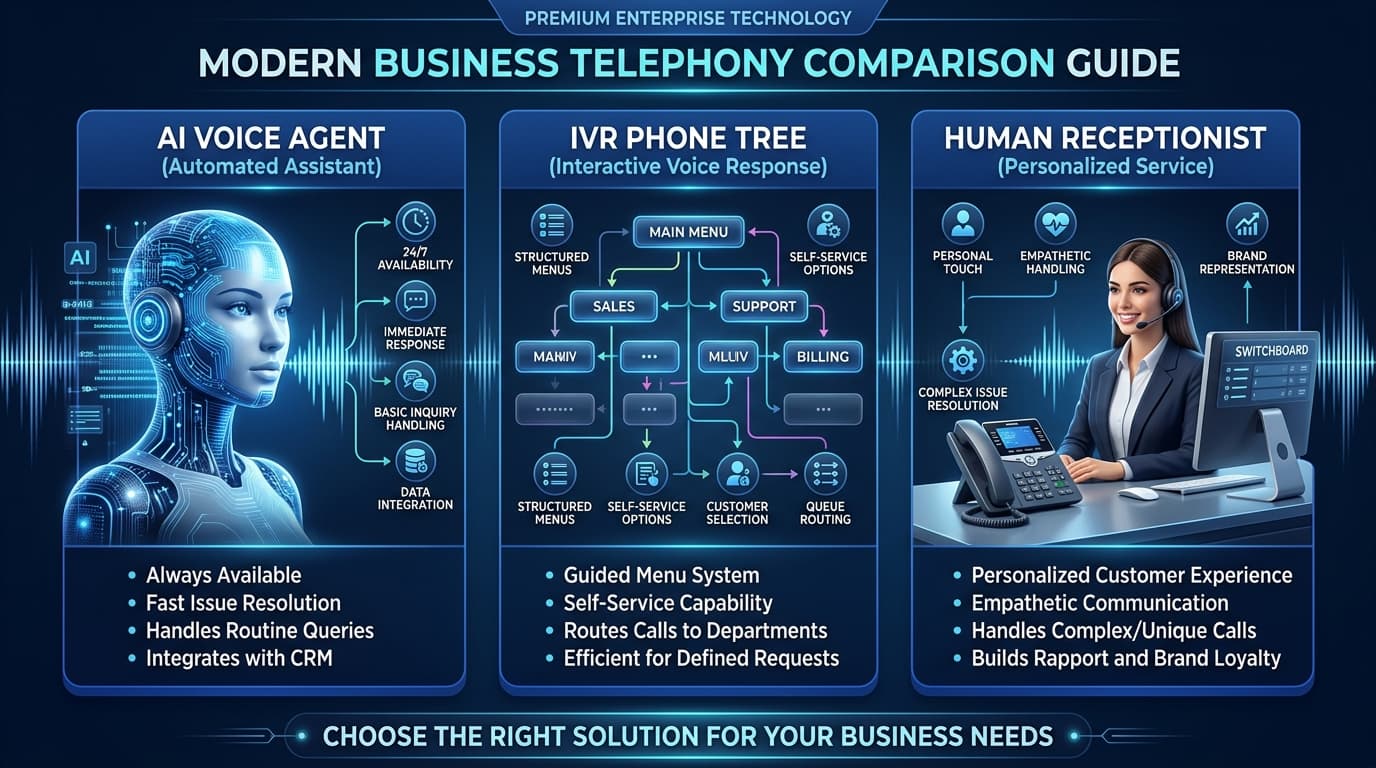
There is no universal winner. IVR tends to suit predictable routing, humans are strongest where judgement and empathy matter, and AI voice agents become more interesting when conversations are repetitive but callers need greater flexibility than a phone menu provides. For many businesses, the most practical answer is a combination of automation and people.
What is the difference between an AI voice agent, IVR and a human receptionist?
An IVR follows predefined call flows, usually collecting keypad presses or particular spoken inputs before giving information or routing the caller. Modern IVRs can support speech as well as touch-tone input, so IVR should not automatically be equated with an old-fashioned "press 1, press 2" system.
An AI voice agent is designed for conversational interaction. Instead of forcing the caller to choose the closest menu option, the system can use speech recognition and natural-language technologies to interpret what the person is saying and formulate a response. Depending on how the particular system is built and integrated, it may also retrieve information or trigger actions in other software.
A human receptionist or phone agent relies on human understanding and judgement. That generally makes people the strongest option when circumstances are unexpected, emotionally sensitive or difficult to encode into reliable business rules.
The real question, therefore, is not:
"Is AI better than IVR?"
It is:
"Which calls should be routed, which should be automated conversationally, and which should still reach a person?"
AI voice agent vs IVR vs human receptionist: quick comparison
| Factor | Traditional IVR | AI voice agent | Human receptionist / phone team |
|---|---|---|---|
| Caller interaction | Menu, keypad or constrained speech | Natural-language conversation | Human conversation |
| Predictability | High | Depends on design and model | Depends on person and situation |
| Simple call routing | Strong | Strong where configured appropriately | Strong, but uses staff time |
| Repetitive enquiries | Limited to configured flows | Potentially strong | Strong |
| Unusual enquiries | Low | Variable | High |
| Emotional or sensitive calls | Low | Limited / depends on use case | High |
| Judgement | Rule-based | Constrained by system and configuration | High |
| Out-of-hours coverage | Can operate continuously | Can operate continuously | Requires staffing or outsourcing |
| Simultaneous demand | Automated capacity can scale | Depends on platform and telephony capacity | Depends on staffing |
| Completing transactions | Possible for predefined self-service | Depends heavily on integrations | Possible within staff permissions |
| Backend integrations | Possible | Often important to usefulness | Staff interact with systems manually or through normal workflows |
| Consistency | High | High for configured policies, though generated responses introduce additional variability | Variable |
| Exception handling | Usually escalates/routes | Needs well-designed fallback and escalation | Strong |
| Setup effort | Call-flow and telephony configuration | Conversation, knowledge, integration, testing and telephony work | Recruitment/outsourcing, training and operational processes |
| Ongoing management | Update menus and routing | Monitor conversations, knowledge, integrations and failure cases | Coaching, training and workforce management |
| Main cost model | Platform + telephony + configuration + maintenance | Platform + usage + telephony + integration/implementation | Salary or outsourced service + management + coverage |
| Best fit | Simple, predictable routing | Repetitive conversational calls and automatable actions | Complex, sensitive or relationship-led conversations |
The boundaries are important. Modern IVR can do more than basic keypad menus, and an AI voice agent does not automatically possess every capability shown in an AI vendor's feature list. What it can actually accomplish depends on its models, integrations, permissions, underlying telephony and how carefully the business has designed the workflow.
1. Traditional IVR: predictable rather than intelligent
Interactive Voice Response is the technology behind familiar experiences such as:
"For sales, press 1. For support, press 2."
An incoming call enters a predefined flow. The system gathers information from the caller and applies rules to decide what happens next.
DTMF is simply the signalling generated by telephone keypad presses. IVR platforms can also support speech recognition, making it possible to gather spoken rather than keypad responses.
This distinction matters because "IVR" and "AI voice agent" are not perfectly clean technical opposites.
Traditional IVR
Typically relies heavily on predetermined menus, permitted responses and routing logic.
Speech-enabled or conversational IVR
Can allow the customer to say something such as "reservations" rather than press a number. More sophisticated implementations can use speech recognition and natural-language processing.
Modern AI voice agent
Moves further towards open conversational interaction, with the system interpreting an utterance, maintaining conversational context and potentially interacting with external systems.
The terminology is not perfectly standard across vendors. Some suppliers use "conversational IVR" for capabilities that others would describe as a voice bot or conversational AI. That is why businesses should compare what the system actually does, rather than buy based on the category label alone.
Where IVR still makes sense
IVR is not automatically obsolete.
Imagine a professional-services firm where almost every incoming call needs one of four destinations:
- new enquiries;
- existing clients;
- accounts;
- reception.
A carefully designed four-option menu may solve the problem perfectly well.
Adding an open-ended AI conversation could introduce complexity without creating much additional value.
IVR is particularly defensible where the business wants deterministic behaviour. Every valid input follows a known route.
Where IVR becomes restrictive
Problems appear when the caller's objective does not map neatly onto the menu.
A hotel guest might say:
"We're arriving late, have two children with us, and need to know whether the restaurant will still be open."
Representing every potential combination like that in a decision tree becomes difficult.
Longer menu structures can also make the caller solve an organisational problem that the business should arguably solve itself: Which internal department owns my issue?
$2
A modern AI voice agent changes the interaction.
Instead of:
Press 1 for reservations.
the conversation might begin:
How can I help?
The caller explains the request naturally.
Under the hood, implementations vary, but technologies can include:
- speech recognition to interpret spoken audio;
- language or conversational models to interpret the request;
- a knowledge source or business rules from which an answer can be produced;
- APIs or other integrations where the agent needs to interact with another system;
- text-to-speech or speech-to-speech technology to provide the audible response.
Automatic speech recognition converts speech into machine-processable text, while text-to-speech technology performs the reverse role by converting text into audio.
Newer architectures can also employ direct speech-to-speech models rather than treating speech-to-text and text-to-speech as completely separate stages.
For a business buyer, however, the architecture matters less than the operational question:
Can the agent understand the calls you actually receive and take the correct action reliably?
Where AI voice agents can be useful
The strongest candidates are usually repetitive but conversational calls.
Think:
- "What time do you close?"
- "Can I change my reservation?"
- "Do you have parking?"
- "Where is my order?"
- "I'd like to book an appointment."
- "Can you put me through to accounts?"
A rigid menu may not be the most natural interface for those enquiries, but using a person for every interaction may also be unnecessary.
An AI voice agent potentially fills that middle ground.
Answering is not the same as acting
This is one of the most important distinctions when comparing vendors.
An agent can tell someone how bookings work using information from a knowledge source.
Actually making or altering a booking is different.
That generally requires access to the relevant booking, CRM, property-management, ticketing or scheduling system, together with appropriate rules and permissions.
So when a supplier says its voice agent can "handle bookings", ask:
- Which system does it read from?
- Can it write back to that system?
- Which actions are permitted?
- How is caller identity verified where necessary?
- What happens if the integration fails?
- How are duplicate or conflicting transactions prevented?
- When does the system stop and transfer the call?
The integration layer can matter as much as the conversation layer.
$3
A human receptionist has obvious constraints.
One person cannot conduct many telephone conversations simultaneously. Continuous coverage requires additional staffing or an outsourced service. Quality can also vary with training, experience and workload.
But people possess something automation still struggles to reproduce reliably: situational judgement.
Consider a caller saying:
"I know your cancellation policy says 24 hours, but my mother has just been taken into hospital."
That conversation is fundamentally different from:
"What time is check-in?"
A person can interpret circumstances, weigh policies against exceptions, ask unforeseen questions and decide that something deserves special handling.
That is why human reception remains particularly useful for:
- sensitive complaints;
- emotionally difficult calls;
- complex negotiations;
- unusual exceptions;
- conversations involving significant discretion;
- premium service environments where human interaction itself is part of the proposition.
The mistake is assuming every call requires that capability.
$4
Businesses do not necessarily have to choose one telephone model.
A hybrid operation can divide calls according to their characteristics:
AI handles
- routine FAQs;
- simple availability enquiries;
- straightforward bookings or changes where integrations permit;
- basic qualification;
- call routing;
- repeatable after-hours enquiries.
Humans handle
- complaints;
- exceptions;
- sensitive requests;
- complex troubleshooting;
- high-value conversations;
- situations in which the AI cannot establish sufficient confidence.
But hybrid only works properly when handoff is designed as a core workflow rather than an emergency escape hatch.
Questions worth asking include:
- What conditions trigger escalation?
- Where does the call go outside normal hours?
- Does the next person receive the context already collected?
- What happens if nobody can take the escalation?
- Can the AI recognise circumstances where it should not attempt an answer?
- What happens during an integration or model failure?
An agent that knows when not to automate can be more useful than one designed to maximise automation at every opportunity.
What can go wrong with an AI voice agent?
AI voice discussions often focus on ideal calls. Buyers should spend at least as much time examining failure cases.
1. The caller is misunderstood
Background noise, unusual names, industry terminology, accents and poor phone connections can all complicate speech processing.
Businesses therefore need to test these conditions rather than assume every conversation will be understood perfectly.
2. The system generates the wrong answer
A conversational system may sound confident even when its underlying information is incomplete or the request falls outside what it should answer.
The correct design response is not simply "better AI".
It can also mean tighter knowledge boundaries, deterministic rules around sensitive actions and escalation when an answer cannot safely be established.
3. The integration fails
The conversation may work perfectly while the connected business system does not.
For example, an agent could understand a request to move an appointment but fail to complete the change because the scheduling system is unavailable.
The customer experience therefore needs an explicit failure path.
4. The request requires judgement
Some calls should not be automated end to end.
A technically capable AI system does not remove the operational responsibility to decide where automation is appropriate.
5. The caller wants a person
Good automation should accommodate this possibility rather than treating human escalation as failure.
The objective is successful call handling, not maximising an "AI containment" statistic.
AI voice agent vs IVR vs human receptionist: what does each actually cost?
Publishing a single generic price comparison would be misleading.
The three models have fundamentally different cost structures.
IVR costs
Typically consider:
- telephony or contact-centre platform charges;
- phone usage;
- implementation/configuration;
- integration work for self-service;
- maintenance when call flows change.
Human reception costs
Depending on the operating model:
- salary and employment costs for in-house staff;
- recruiting and training;
- shift or out-of-hours coverage;
- management;
- or the per-minute, per-call or package costs of an outsourced answering service.
AI voice agent costs
Potential components include:
- voice-AI platform charges;
- telephone usage;
- AI/model usage;
- implementation;
- connections with CRM, booking or operational systems;
- monitoring and ongoing optimisation.
The crucial calculation is consequently total cost for the operating model you actually need, not simply "AI licence versus receptionist salary".
A business receiving 30 simple calls a week has a radically different decision from one dealing with large peaks of repetitive inbound enquiries.
What about an answering service or call centre?
An answering service effectively introduces another form of human handling.
At the simpler end it may capture the caller's details and pass a message to the business. More capable virtual receptionist services can carry out additional tasks depending on the service purchased.
The comparison is therefore not simply AI versus employee.
You may be evaluating:
- in-house receptionist;
- outsourced virtual receptionist;
- call centre;
- IVR;
- AI voice agent;
- or combinations of these.
For outsourced services, ask the same operational questions:
- What can the operator resolve independently?
- What information can they access?
- Can they perform transactions?
- How are unusual calls escalated?
- What happens during peaks?
- How is the service charged?
This avoids the common mistake of assuming every human answering service is merely a message-taking service.
Four examples of choosing the right approach
These examples are hypothetical, not HuemanAI customer case studies.
Scenario 1: Small professional-services firm
A consultancy receives relatively few calls. Most simply need to reach sales, accounts or an individual employee.
Possible fit: IVR or human reception.
If the requirement really is deterministic routing, conversational AI may solve a problem the company does not have.
Scenario 2: Hotel with repetitive guest and reservation calls
A hotel receives questions about check-in, parking, dining, availability and existing reservations, including outside normal front-desk staffing periods.
Possible fit: AI + human hybrid.
Repeatable enquiries may be candidates for conversational automation, particularly where appropriate systems can be connected. Complaints, unusual requests and sensitive guest situations can be escalated to staff.
This is where integration becomes particularly important. A hotel voice agent that can converse but cannot access the operational data necessary for the requested task may solve only part of the problem.
Scenario 3: Restaurant during dinner service
Staff are serving guests while the phone rings with questions about opening hours, reservations and availability.
Possible fit: AI voice agent, answering service or hybrid.
The important questions are whether reservations can be handled safely through the live booking system and which calls genuinely require a staff member.
Scenario 4: Complex support operation
A company receives large numbers of routine account enquiries alongside difficult technical issues and complaints.
Possible fit: multiple layers.
IVR may still provide deterministic routing for certain callers. Conversational automation may resolve repeatable requests. Human specialists can then concentrate on cases requiring genuine investigation or judgement.
There is no requirement for the entire organisation to use one model.
UK privacy and call-recording considerations
UK businesses also need to consider data protection when introducing voice AI.
The Information Commissioner's Office (ICO) provides guidance on applying UK data-protection principles to AI systems that process personal data. Relevant considerations include lawfulness, fairness, transparency, accountability and risk.
Voice systems raise additional questions if calls are recorded or transcribed. Ofcom notes that several UK laws may be relevant to telephone recording and says legal advice may be appropriate because the area is complex.
For buyers, practical due-diligence questions include:
- Are calls recorded or transcribed?
- What personal data is collected?
- Why is that information being processed?
- Where is it stored and for how long?
- Which suppliers or subprocessors receive it?
- Is data used for model training?
- How are recordings, transcripts and account information protected?
- What information is given to callers about the processing?
- What happens when sensitive information is disclosed?
- Has the organisation assessed whether a DPIA is appropriate?
Do not accept "GDPR compliant" as a sufficient answer on its own. Compliance depends on the particular processing, technology and organisational practices, not merely the product category.
This section is informational rather than legal advice.
How to decide which phone model fits your business
Rather than comparing feature lists, start with your actual calls.
Step 1: Sample your inbound calls
Take a representative period and classify calls into categories such as:
- simple routing;
- repetitive information;
- repeatable transaction;
- complex enquiry;
- sensitive conversation;
- exception.
The percentage in each category is much more useful than total call volume alone.
Step 2: Ask whether the caller actually needs conversation
If callers merely need to choose between sales, support and billing, IVR may be entirely adequate.
Do not add conversational AI simply because it is newer.
Step 3: Identify which calls require judgement
Mark anything involving:
- sensitive circumstances;
- complaints;
- complex negotiation;
- safety;
- significant discretion;
- unusual exceptions.
Those calls deserve especially careful consideration before automation.
Step 4: Identify required system access
For every automated action, document the system that would have to be read or changed.
"Check my booking" and "change my booking" may sound similar to a caller, but they are operationally different requirements.
Step 5: Design escalation before automation
Decide what happens when the system:
- cannot understand someone;
- does not know the answer;
- encounters conflicting information;
- cannot reach an external system;
- recognises a sensitive case;
- or is simply asked for a human.
Step 6: Compare the total operating models
Finally compare:
IVR: telephony + platform + configuration + maintenance.
Humans: staffing/outsourcing + training + management + coverage.
AI: platform + usage + telephony + integration + implementation + ongoing monitoring.
Then compare those costs against the kinds of calls each model actually resolves appropriately.
So, should you choose IVR, an AI voice agent or a human receptionist?
Here is the simplest decision framework.
Choose traditional IVR when
- most calls only need straightforward routing;
- the available paths are few and predictable;
- deterministic behaviour matters;
- natural conversation would add little value.
Keep humans central when
- calls regularly require judgement;
- emotional intelligence is important;
- requests frequently fall outside predictable processes;
- the human interaction itself forms part of the service.
Investigate an AI voice agent when
- inbound calls are repetitive but conversational;
- after-hours answering is useful;
- callers would benefit from stating their request naturally;
- common enquiries or actions can be defined safely;
- the necessary business systems can be integrated appropriately.
Consider AI + humans when
- a meaningful proportion of calls are repetitive;
- another meaningful proportion requires human judgement;
- you can define reliable escalation boundaries.
For many operations, that fourth model is the more useful question.
The objective should not be to remove people from phone calls. It should be to use the simplest reliable method for each kind of call.
Questions to ask an AI voice provider before buying
If conversational AI looks appropriate, ask prospective suppliers:
- What happens when the agent does not know the answer?
- How does human escalation work?
- Which parts of the conversation are generated and which are deterministic?
- What business systems can actually be connected?
- Can the agent both read and update those systems where required?
- How are permissions controlled?
- How is personally identifiable or sensitive information handled?
- Are calls recorded or transcribed?
- How long are recordings and transcripts retained?
- What data is used to improve or train models?
- How do you test accents, interruptions and background noise?
- What happens when an integration is unavailable?
- How do we review failed or escalated conversations?
- How is pricing affected by call duration and volume?
- What ongoing work will our team need to perform?
Those answers will normally tell you more than a demo in which the agent handles a perfectly scripted call.
Where HuemanAI fits
For hospitality operators specifically, HuemanAI's wider AI operations and concierge proposition is relevant to this decision because phone interactions often sit alongside reservations and guest-service workflows.
If you are assessing whether conversational AI belongs in that operating model, you can explore HuemanAI's AI operations and concierge software and compare the approach against the call types identified above.
The practical question to bring to that conversation is not "Can AI replace my receptionist?"
It is:
"Which of our calls are predictable enough to automate, which require a conversation, and exactly when should a person take over?"
That's a much better basis for choosing between IVR, voice AI and human reception.
Evaluate Voice AI for Your Front Desk and Phone Lines
Discover how HuemanAI's conversational voice agents handle repetitive guest enquiries and reservations 24/7 while seamlessly routing sensitive calls to your human team.
Frequently Asked Questions
Is an AI voice agent the same as IVR?
No. Traditional IVRs generally use predefined menus and routing logic, although modern IVRs can accept both DTMF keypad and spoken input. AI voice agents put greater emphasis on natural-language conversation and can potentially perform actions across connected systems. The boundary is not absolute because modern conversational IVR incorporates AI technologies too.
Is conversational IVR the same as an AI voice agent?
Not necessarily. "Conversational IVR" can describe an IVR enhanced with speech recognition and natural-language understanding, while modern AI voice agents may incorporate generative models, more open-ended dialogue and agent-like actions. Vendor terminology varies, so compare capabilities rather than names.
Can an AI voice agent replace a receptionist?
For some repeatable telephone tasks, AI may reduce the need for a person to handle every call. That does not mean it can universally replace a receptionist. Calls requiring empathy, judgement, exceptions or sensitive handling may still be better suited to people.
Is AI voice cheaper than IVR?
Not inherently. IVR and AI have different cost structures. A simple menu may be inexpensive relative to implementing a conversational system, while a more complex AI deployment can involve platform, telephony, model, integration and implementation costs. Compare total costs using your actual calls rather than market-wide averages.
Can AI voice agents answer calls 24/7?
Software-based phone systems can be designed to operate outside staffed business hours, but actual availability depends on the service architecture, telephony, connected systems and provider arrangements. It is better treated as a deployment capability than an automatic property of every AI product.
Do AI voice agents integrate with CRM or booking systems?
Some can, but integrations are product-specific. Buyers should verify the exact read/write capabilities, permissions and failure handling of the solution being considered.
Is an AI voice agent GDPR compliant?
That question cannot be answered solely from the label "AI voice agent". UK data-protection compliance depends on how personal data is collected, processed, stored, shared and protected, as well as the organisation's lawful basis, transparency and governance.
Sources and further reading
- ICO: Guidance on AI and data protection
- ICO: Artificial intelligence and data protection resources
- Ofcom: Personal data, privacy and recording calls
- Twilio: Interactive Voice Response documentation
- Amazon Transcribe: speech-to-text
- Amazon Polly: text-to-speech
- Amazon Lex: conversational AI interfaces
About the Author
Ankur Handoo is Co-Founder of Hueman AI, specialising in conversational AI agents, autonomous phone handling, and hospitality operations automation. Hueman AI builds enterprise voice and concierge systems that connect seamlessly with leading PMS and booking platforms across the UK.
About Hueman AI
Hueman AI specialises in delivering cutting-edge AI voice solutions tailored for the UK hospitality sector. Our intelligent voice agents integrate seamlessly with your existing systems, delivering 24/7 service excellence whilst reducing operational costs. Discover how we're helping British hotels, restaurants, and hospitality venues transform guest experiences and boost revenue.
Contact us today to explore how AI voice technology can elevate your property's service delivery and competitive positioning in the UK market.