
The AI Revolution: How Hotel Chatbots and Virtual Concierges Drive Direct Bookings and Elevate the Guest Experience
The hospitality industry stands at a transformative crossroads. As guest expectations evolve toward instant, personalized service and hotels face mounting pressure to increase direct bookings while controlling operational costs, a new technology has emerged as the definitive solution: the AI-powered hotel chatbot.
A Hotel Chatbot is an AI-powered software designed to act as a Virtual Concierge, handling guest inquiries, managing bookings, and automating service requests across multiple digital channels 24/7. Its primary goal is to enhance the Guest Experience and increase Direct Bookings.
This comprehensive guide explores how next-generation hotel chatbots are revolutionizing hospitality operations, driving revenue through direct channels, and creating exceptional guest experiences from pre-arrival through post-departure.
Table of Contents
- Understanding the Modern Hotel Chatbot vs. The Legacy Virtual Concierge
- The Direct Booking Engine: Chatbots as Revenue Drivers
- Redefining the Guest Experience Cycle (Pre-Stay to Post-Stay)
- Key Benefits: Operational Efficiency and Staff Empowerment
- Implementation & Integration: Selecting the Right Hotel Chatbot Platform
- Future Trends: The Role of Voice AI and Hyper-Personalization
- Frequently Asked Questions
Understanding the Modern Hotel Chatbot vs. The Legacy Virtual Concierge
The terminology surrounding automated guest service technology has evolved significantly. Understanding the distinction between traditional virtual concierge systems and modern hotel chatbots is essential for hoteliers evaluating their technology investments.
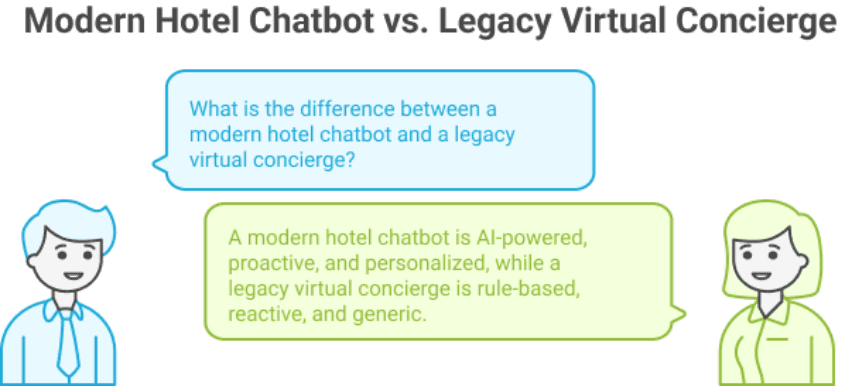 Modern hotel chatbots use conversational AI to engage guests naturally across multiple channels
Defining the Hotel Chatbot: More Than Just an FAQ Handler
Traditional virtual concierge solutions often consisted of static mobile applications or lobby kiosks that provided basic property information, restaurant recommendations, and local attraction guides. While useful, these systems required guests to navigate menus and search for information proactively.
Modern hotel chatbots fundamentally differ by enabling conversational interactions. These AI-powered systems engage guests through natural language processing, understanding context and intent to provide immediate, personalized responses. A hotel chatbot serves as the digital embodiment of a virtual concierge, available across multiple channels including website chat widgets, WhatsApp, SMS, Facebook Messenger, and mobile applications.
The chatbot's intelligence extends beyond answering frequently asked questions. It actively participates in the booking process, manages service requests, coordinates with property management systems, and learns from each interaction to continuously improve response accuracy and relevance.
The Core Difference: Rule-Based Automation vs. Generative AI
Legacy virtual concierge systems operated on rule-based logic, following predetermined decision trees. If a guest's question didn't match pre-programmed scenarios, the system would fail to provide adequate assistance, leading to frustration and abandoned inquiries.
Contemporary hotel chatbots leverage generative AI and large language models (LLMs) to understand complex, nuanced questions. This technological leap enables the chatbot to:
- Comprehend guest intent even with unconventional phrasing or multiple simultaneous questions
- Provide contextually relevant answers by understanding the entire conversation history
- Handle sophisticated requests that require synthesizing information from multiple sources
- Escalate seamlessly to human staff when the query requires personal judgment or falls outside automated capabilities
This evolution from rigid automation to intelligent conversation represents a paradigm shift in how hotels deliver digital guest experiences. The hotel chatbot becomes a true virtual concierge rather than a glorified FAQ database.
| Feature | Legacy Virtual Concierge | Modern Hotel Chatbot (Generative AI) | | :--- | :--- | :--- | | Technology Foundation | Rule-based decision trees | Large Language Models (LLMs) | | Communication Style | Menu-driven navigation | Natural language conversation | | Understanding Capability | Keyword matching only | Context and intent recognition | | Learning Ability | Static programming | Continuous learning from interactions | | Complex Query Handling | Frequent failures | High success rate with escalation | | Integration Depth | Limited APIs | Full PMS, CRM, CRS integration |
The Direct Booking Engine: Chatbots as Revenue Drivers
The economic rationale for implementing hotel chatbots extends far beyond guest satisfaction metrics. These systems directly impact the bottom line by transforming casual website visitors into confirmed reservations while maximizing revenue per booking.
Hotel Chatbots increase Direct Bookings by providing immediate price and availability checks, offering promotional codes unavailable on OTAs, and guiding users through the booking process without relying on human staff, minimizing abandonment rates.
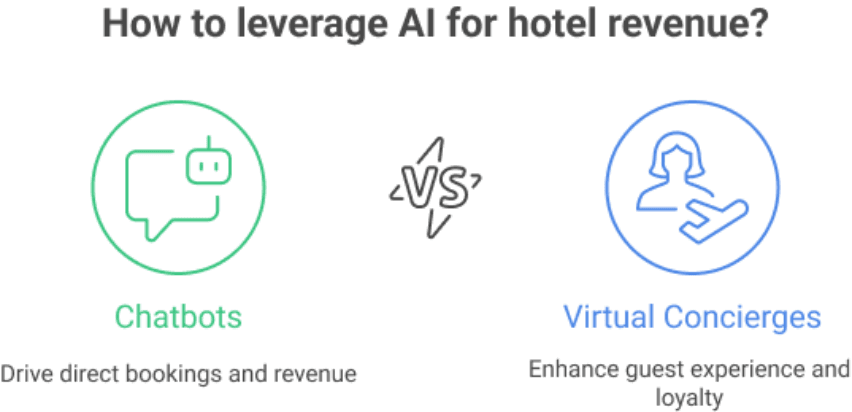 Conversational booking reduces friction and increases direct booking conversion rates by 20-35%
Reducing Conversion Friction through Conversational Booking
Traditional online booking engines present a cognitive challenge to prospective guests. Users must input dates, select room types from descriptions that may not fully answer their questions, navigate complex rate structures, and complete forms before seeing the final price.
A hotel chatbot eliminates this friction by guiding guests through a conversational booking experience:
Guest: "I need a room for two adults next weekend near the beach"
Chatbot: "I'd be happy to help! I have ocean-view suites available for check-in Friday, December 20th and check-out Sunday, December 22nd. The rate is $289 per night, which includes breakfast and beach amenity access. Would you like to see photos of the suite?"
This natural interaction reduces the cognitive load on potential guests while simultaneously increasing conversion rates. Industry research indicates that conversational booking interfaces can improve website conversion rates by 20-35% compared to traditional booking engines.
The chatbot's ability to answer questions in real-time addresses objections immediately, preventing the research paralysis that often leads to abandoned bookings. When a guest asks about parking availability, pet policies, or late checkout options during the conversation, the hotel chatbot provides instant answers without requiring the user to navigate away from the booking flow.
Real-Time Inventory Checks and Dynamic Pricing Integration
Modern hotel chatbots integrate directly with property management systems and channel managers, accessing real-time inventory availability and dynamic pricing data. This integration ensures that every recommendation and quote the chatbot provides reflects current availability, eliminating the frustration of "ghost inventory" that plagues many online booking systems.
The chatbot can also implement sophisticated revenue management strategies by:
- Presenting premium room categories with value-added justifications when standard rooms are scarce
- Offering time-sensitive promotional rates to create urgency for immediate booking
- Suggesting alternative dates when the guest's preferred dates show limited availability at higher price points
- Highlighting direct booking benefits such as complimentary upgrades, flexible cancellation policies, or loyalty program advantages unavailable through online travel agencies
This strategic positioning of the hotel chatbot as a direct booking channel reduces dependency on OTAs, which typically charge commission rates of 15-25% per reservation. A property generating 100 direct bookings monthly through chatbot assistance, with an average daily rate of $200 for three-night stays, could save $90,000 to $150,000 annually in commission fees.
The Power of Upselling and Cross-Selling Automation
The revenue optimization capabilities of hotel chatbots extend beyond the initial booking. These systems excel at automated upselling and cross-selling throughout the guest journey.
During the booking conversation, the chatbot can introduce upgrade opportunities organically:
Chatbot: "Your deluxe room is confirmed for $229 per night. For an additional $60 per night, you can upgrade to our executive suite with a private balcony and evening cocktail service. Many guests celebrating special occasions choose this option. Would you like to upgrade?"
Post-booking but pre-arrival, the virtual concierge can promote additional services through personalized messages:
- Spa reservations with pre-arrival discount codes
- Airport transfer services highlighting convenience and competitive pricing
- Special dining experiences or chef's table reservations
- Early check-in or late checkout options with dynamic pricing based on availability
Industry data suggests that automated upselling through chatbot interactions generates an average of 15-25% incremental revenue per booking, with acceptance rates significantly higher than email-based upselling approaches due to the conversational, personalized nature of the recommendation.
| Metric | Average Impact | | :--- | :--- | | Direct Booking Conversion Rate Increase | +25-35% | | OTA Commission Savings (per booking) | $45-75 | | Upsell Revenue per Booking | +15-25% | | Booking Abandonment Reduction | -30-40% | | Average Query Response Time | Under 2 seconds |
Redefining the Guest Experience Cycle (Pre-Stay to Post-Stay)
The transformative power of hotel chatbots manifests most clearly in their ability to enhance every touchpoint of the guest experience. From the moment a reservation is confirmed until weeks after departure, the virtual concierge maintains continuous, valuable engagement.
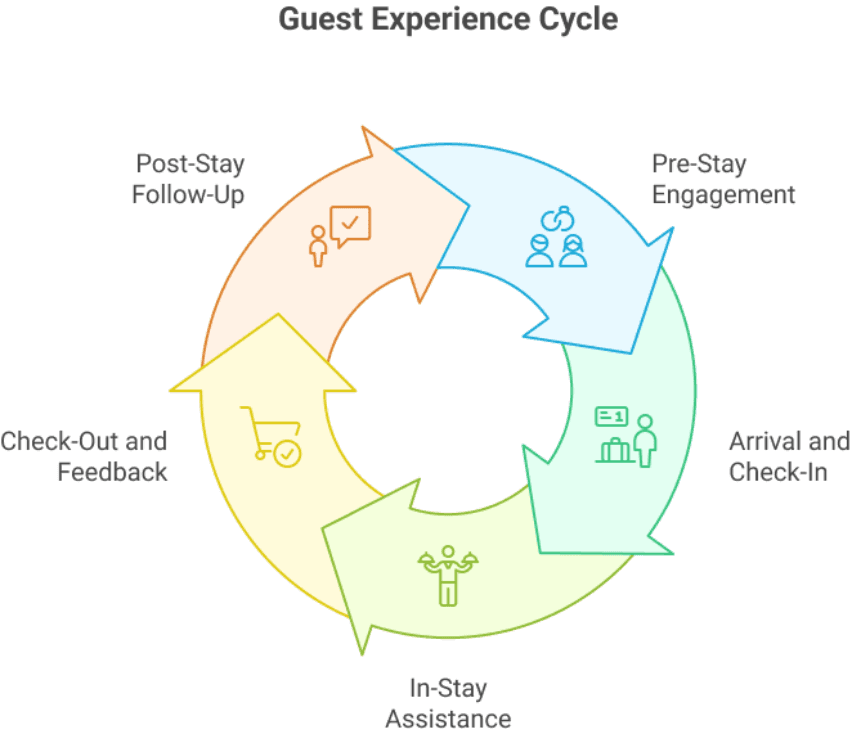 Proactive pre-arrival communication streamlines check-in and establishes positive guest momentum
Pre-Arrival: Streamlining Check-in and Information Gathering
The pre-arrival phase represents a critical opportunity to establish positive momentum in the guest experience while simultaneously reducing operational burden during check-in.
Modern hotel chatbots initiate proactive outreach to confirmed guests, typically 48-72 hours before arrival:
Chatbot: "Hi Sarah! We're excited to welcome you to [Hotel Name] this Friday. To expedite your check-in, I can help you complete the registration process now. May I ask a few quick questions?"
This conversational pre-registration collects essential information including:
- Government-issued identification details
- Payment method authorization
- Special requests or preferences (high floor, away from elevators, extra pillows)
- Estimated arrival time
- Interest in additional services
The chatbot simultaneously provides valuable pre-arrival information, answering common questions about parking, amenities, local attractions, and property policies. This proactive communication reduces the volume of phone calls to the front desk while creating a sense of personalized attention that enhances the overall guest experience.
For properties implementing mobile key technology, the hotel chatbot can facilitate digital key delivery, explaining the process and troubleshooting any technical issues before the guest arrives. This seamless integration between the virtual concierge and physical property operations exemplifies how technology enhances rather than replaces human service.
In-Stay: Instant Answers and Service Requests (The 24/7 Virtual Concierge)
The core benefit of an AI Virtual Concierge is the ability to provide instant, personalized, and multilingual support at scale, significantly reducing front desk call volume by 60% and freeing staff for high-value face-to-face interactions.
During the stay, guest expectations have fundamentally shifted toward immediacy. When a guest wants extra towels at 11 PM, information about breakfast hours at 6 AM, or a restaurant recommendation at any hour, they no longer want to call the front desk and potentially wait on hold.
The hotel chatbot provides instantaneous responses to common inquiries:
- Amenity information (pool hours, gym access, business center)
- Dining options, hours, and menu highlights
- Service requests (housekeeping items, maintenance issues)
- Local recommendations (restaurants, attractions, transportation)
- Property navigation assistance
- Billing inquiries and checkout time confirmation
For service requests, the chatbot integrates with property operations systems to create work orders automatically. When a guest reports a malfunctioning thermostat through the chat interface, the system immediately notifies maintenance, logs the issue in the PMS with room number and guest preference details, and confirms to the guest that assistance is en route.
This seamless request management eliminates the telephone game of multiple staff handoffs, reduces response time, and creates a documented service trail for quality assurance purposes.
The multilingual capabilities of modern hotel chatbots deserve particular emphasis. International guests can interact with the virtual concierge in their native language, dramatically improving comfort and satisfaction. Rather than struggling with language barriers at the front desk or relying on translation apps, guests engage naturally with a system that understands context and cultural nuances across dozens of languages.
Post-Stay: Reputation Management and Loyalty Nurturing
The guest relationship doesn't end at checkout. Strategic post-departure engagement through the hotel chatbot creates opportunities for reputation management, loyalty development, and future booking cultivation.
Within 24 hours of departure, the chatbot initiates a feedback conversation:
Chatbot: "Thank you for staying with us, Michael! We hope you enjoyed your visit. Would you mind sharing what you liked most about your stay? Your feedback helps us continue improving."
This conversational approach to feedback collection generates significantly higher response rates than traditional email surveys. The informal, brief nature of the interaction reduces friction while the immediate timing captures authentic impressions before they fade from memory.
The chatbot's sentiment analysis capabilities can identify positive feedback and immediately request public reviews on key platforms like Google, TripAdvisor, or OTA sites. For constructive criticism or negative feedback, the system can alert management for immediate follow-up before the guest posts a public review.
Beyond reputation management, the virtual concierge nurtures ongoing relationships by:
- Sending personalized special offers for future stays based on previous booking patterns
- Celebrating guest birthdays or anniversaries with exclusive promotional codes
- Providing updates about property renovations, new amenities, or local events that might interest returning guests
- Facilitating easy rebooking through conversational prompts: "We'd love to welcome you back! Would you like to see our rates for spring break?"
This continuous, low-pressure engagement maintains top-of-mind awareness and cultivates loyalty more effectively than periodic email newsletters that often go unread.
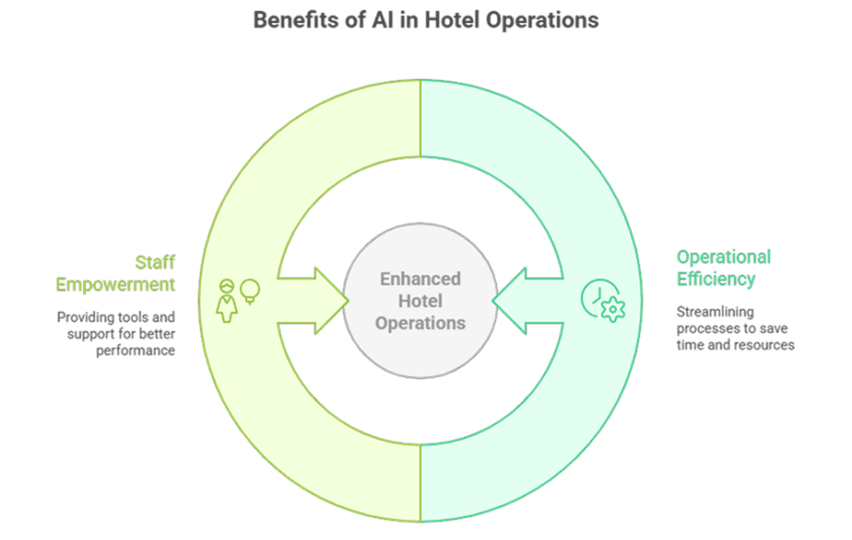
Key Benefits: Operational Efficiency and Staff Empowerment
While guest experience improvements provide the most visible benefits of hotel chatbot implementation, the operational and financial advantages significantly impact property profitability and staff satisfaction.
Quantifying the ROI: Labor Cost Reduction and Productivity
Front desk operations traditionally require significant staffing to manage phone inquiries, answer basic questions, coordinate service requests, and process bookings. Industry analysis indicates that 60-70% of front desk phone calls involve routine inquiries that a hotel chatbot can address instantly and accurately.
By deflecting these repetitive interactions to automated channels, properties can optimize staffing levels during lower-demand periods while maintaining service quality. A 150-room property might reduce front desk staffing from three concurrent agents to two during off-peak shifts, generating annual labor savings of $35,000 to $50,000 while simultaneously improving response times for guests who prefer digital communication.
The productivity gains extend beyond simple call deflection. Staff members freed from answering repetitive questions can focus on high-value activities:
- Proactive guest engagement with VIP arrivals
- Resolving complex issues that require human judgment and empathy
- Coordinating with other departments to orchestrate exceptional experiences
- Training and professional development activities
- Revenue-generating activities like event sales or partnership development
This reallocation of human capital from routine task execution to relationship building and problem-solving creates a more satisfying work environment for staff while delivering measurable financial returns through improved operational efficiency.
Multilingual Support and Omnichannel Presence
International guest expectations for native-language service create significant operational challenges for properties that lack multilingual staff. Hiring qualified employees fluent in multiple languages dramatically increases labor costs and recruiting complexity.
A hotel chatbot eliminates this constraint by providing fluent, contextually accurate communication in dozens of languages simultaneously. Whether a guest initiates conversation in Mandarin, Spanish, Arabic, or Portuguese, the virtual concierge responds with the same level of sophistication and accuracy.
This capability proves particularly valuable for properties in tourist destinations or gateway cities where diverse international clientele is common. Rather than relying on translation apps or limiting non-English speakers to simplified communication, the chatbot facilitates rich, nuanced interactions that meaningfully enhance the guest experience.
The omnichannel nature of modern hotel chatbots further extends operational efficiency. The same AI-powered system manages conversations across:
- Website chat widgets for pre-booking inquiries
- WhatsApp for convenient mobile messaging
- SMS for guests who prefer text messaging
- Facebook Messenger for social media-native users
- In-app messaging for properties with dedicated mobile applications
- Email integration for guests who prefer that channel
This unified approach creates conversation continuity across channels. A guest who begins an inquiry on the website, continues via WhatsApp, and concludes through SMS experiences seamless interaction history without repeating information. The hotel chatbot maintains complete context, creating an effortless guest experience while centralizing communication management for property staff.
Implementation & Integration: Selecting the Right Hotel Chatbot Platform
The technical sophistication required for effective hotel chatbot deployment demands careful platform selection and strategic implementation planning. Success depends on choosing solutions that integrate seamlessly with existing property systems while providing the flexibility to customize guest interactions.
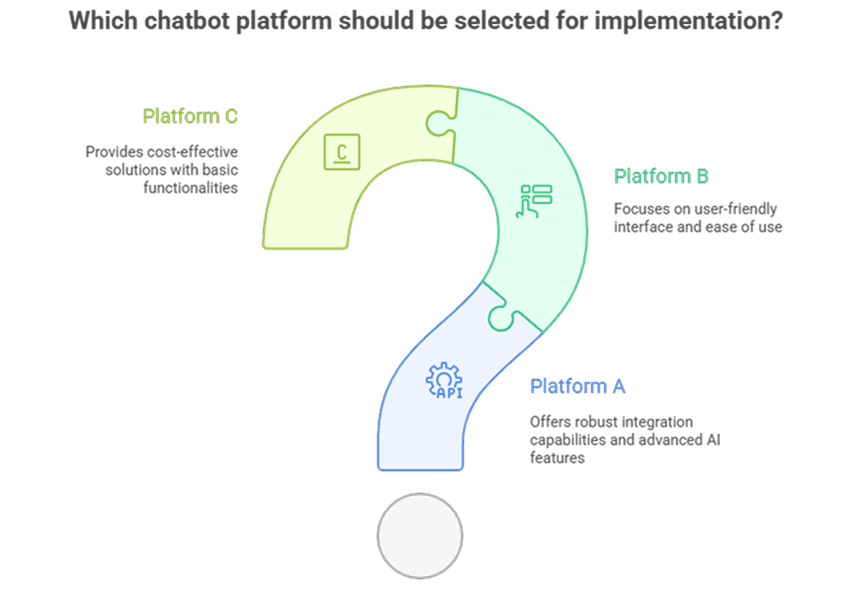 Essential integrations enable the chatbot to function as a true revenue-generating booking channel
Essential Integrations (PMS, CRM, Booking Engine)
The transformative capabilities of hotel chatbots rely fundamentally on deep integration with core property systems. Standalone chatbots that operate independently from operational infrastructure provide minimal value beyond basic FAQ functionality.
Essential integration requirements include:
Property Management System (PMS) Integration: The chatbot must access real-time reservation data, guest profiles, room inventory, and service request systems. This integration enables the virtual concierge to provide accurate information about bookings, facilitate modifications, coordinate service delivery, and maintain complete conversation history within the guest profile for future reference.
Central Reservation System (CRS) Integration: Direct access to booking inventory, rate plans, and availability enables the hotel chatbot to function as a revenue-generating booking channel. The integration should support real-time inventory checks, dynamic pricing display, promotional code application, and seamless reservation creation without manual staff intervention.
Customer Relationship Management (CRM) Integration: Sophisticated guest engagement requires access to preference data, loyalty program status, previous stay history, and communication preferences. The chatbot leverages this information to personalize interactions, tailor recommendations, and provide contextually relevant service throughout the guest journey.
Payment Processing Integration: For properties implementing pre-arrival payment collection, guarantee verification, or in-chat booking completion, secure payment processing integration is essential. The system must comply with PCI DSS standards while providing convenient, frictionless payment experiences.
Task Management and Work Order Systems: When guests request services through the chatbot, automatic work order creation and assignment ensures prompt response. Integration with housekeeping management systems, maintenance tracking software, and concierge ticketing platforms creates accountability and documentation for every guest request.
Properties should evaluate potential chatbot platforms based on pre-built integrations with their existing technology stack. Implementation timelines and costs increase dramatically when custom API development is required for every system connection.
Customization and Brand Voice Alignment
Generic, robotic chatbot interactions undermine the guest experience and fail to reinforce property brand identity. Effective hotel chatbot implementation requires substantial customization to ensure the virtual concierge reflects brand personality, service standards, and property-specific information.
Key customization elements include:
Conversational Tone and Personality: A boutique lifestyle hotel requires dramatically different chatbot communication style than a business-focused airport property or family resort. The virtual concierge should employ vocabulary, humor, and formality levels consistent with brand positioning and target guest demographics.
Visual Design Integration: The chat interface should incorporate brand colors, typography, and design elements that create visual consistency with the property website and marketing materials. Custom avatars or profile images enhance recognition and brand association.
Property-Specific Knowledge Base: The chatbot requires comprehensive training on unique property features, local partnerships, special programs, and distinctive service offerings that differentiate the hotel from competitors. Generic responses about "the fitness center" fail to convey the distinctive value of "our 24-hour wellness studio with Peloton equipment and complimentary yoga classes."
Response Customization: While AI-powered systems generate dynamic responses, properties should establish guardrails and preferred phrasing for key topics. Brand-mandated terminology for room categories, amenities, and service descriptions ensures consistency across all guest touchpoints.
Escalation Protocols: Clear definition of conversation types requiring human intervention protects brand reputation. Complex complaints, special accommodation requests, or safety-related issues should trigger immediate staff notification rather than attempted automated resolution.
Properties with multiple locations or brands face additional complexity ensuring each chatbot instance reflects the appropriate identity while leveraging shared infrastructure and AI capabilities.
Future Trends: The Role of Voice AI and Hyper-Personalization
The evolution of hotel chatbot technology continues accelerating, with emerging capabilities promising even more sophisticated guest engagement and operational optimization.
Voice-Activated Virtual Concierge: The integration of conversational AI with voice interfaces extends chatbot accessibility beyond text-based channels. Guests can interact with the virtual concierge through smart speakers in guest rooms, mobile device voice assistants, or property-wide voice networks. This hands-free interaction proves particularly valuable for accessibility, multitasking scenarios, and guests with visual impairments.
Properties implementing voice-enabled hotel chatbots must address privacy concerns through transparent disclosure, opt-in activation models, and robust data protection protocols. However, the convenience and natural interaction pattern of voice communication positions this modality for significant growth in hospitality applications.
Predictive Service Delivery: Machine learning analysis of historical guest behavior patterns enables proactive service suggestions. If the system identifies that a returning guest typically requests extra pillows, orders room service breakfast, and use late checkout, the chatbot can proactively offer these services before the guest inquires. This anticipatory service approach elevates the guest experience from reactive accommodation to predictive personalization.
Emotion Recognition and Sentiment Adaptation: Advanced natural language processing can detect emotional states through word choice, punctuation, and conversation patterns. A hotel chatbot capable of identifying guest frustration can automatically adjust response tone, offer compensation proactively, and escalate to human staff before the situation deteriorates. Similarly, detected excitement or celebration can trigger personalized congratulatory messages and relevant upgrade or enhancement offers.
Augmented Reality Integration: Future virtual concierge implementations may incorporate AR capabilities, allowing guests to point their mobile device camera at property features or local landmarks and receive immediate contextual information through the chatbot interface. This visual-conversational hybrid creates intuitive wayfinding, educational content delivery, and experiential enhancement opportunities.
Blockchain-Based Loyalty Integration: As hospitality loyalty programs explore blockchain technology for transparent reward tracking and interoperability, hotel chatbots will serve as the primary interface for real-time point balance inquiries, redemption transactions, and NFT-based status token management.
The trajectory of hotel chatbot evolution points toward increasingly sophisticated, context-aware, and proactive guest engagement that blurs the distinction between automated and human service delivery. Properties that establish strong chatbot foundations today position themselves to rapidly adopt these emerging capabilities as they mature.
Frequently Asked Questions
1. What is a hotel virtual concierge chatbot?
A virtual concierge chatbot handles guest chat — via web widget, WhatsApp, or SMS — answering questions about amenities, local recommendations, and booking requests without a staff member manually replying to every message.
2. How does a hotel chatbot drive direct bookings specifically?
By capturing booking intent inside the chat itself — quoting live rates and availability and completing the reservation — rather than sending the guest to compare prices on an OTA elsewhere.
3. What's the difference between a basic hotel chatbot and an AI concierge?
A basic chatbot typically follows scripted decision trees; an AI concierge like HuemanAI's understands natural language, pulls live PMS data, and can handle open-ended requests rather than only pre-set menu options.
4. Can a hotel virtual concierge chatbot handle in-stay guest requests, not just pre-arrival questions?
Yes — platforms like HuemanAI's AI Concierge Agent handle in-stay requests such as extra towels, late check-out, or restaurant recommendations, converting them into staff tickets automatically where needed.
5. Does a hotel chatbot replace the need for a website booking engine?
No — a chatbot typically works alongside a hotel's existing booking engine, capturing guests who'd otherwise leave the site or call, rather than replacing the core reservation system itself.
6. How many languages should a hotel virtual concierge chatbot support?
For hotels with international guests, broad language coverage matters — HuemanAI states 40+ languages with automatic detection as standard on its concierge and chat products.
7. What ROI can a hotel expect from adding a virtual concierge chatbot?
Results vary, but HuemanAI cites 30-48% more direct bookings and up to 85% fewer routine front-desk calls as reference figures from its own AI concierge and receptionist products.
8. How quickly can a hotel launch a virtual concierge chatbot?
Implementation timelines vary by vendor; HuemanAI states most properties are live within 48 hours, including brand-voice configuration and PMS integration.
Conclusion: The Essential Technology for Modern Hospitality
The hotel chatbot has evolved from experimental novelty to essential infrastructure for competitive hospitality operations. Properties that view this technology merely as a customer service tool miss the transformative potential for revenue optimization, operational efficiency, and guest experience differentiation.
Successful implementation requires strategic planning, comprehensive system integration, thoughtful customization, and ongoing optimization based on performance analytics and guest feedback. The investment—both financial and organizational—delivers measurable returns through increased direct bookings, reduced operational costs, improved staff productivity, and enhanced guest satisfaction metrics.
As guest expectations continue evolving toward immediacy, personalization, and seamless digital experiences, the hotel chatbot and virtual concierge capabilities will increasingly distinguish market leaders from competitors relying solely on traditional service delivery models. Properties that establish sophisticated chatbot foundations today position themselves to rapidly adopt emerging capabilities including voice interaction, predictive service, and hyper-personalization as these technologies mature.
The question for hospitality operators is no longer whether to implement hotel chatbot technology, but rather how quickly they can deploy comprehensive solutions that transform guest engagement, optimize revenue channels, and empower staff to focus on the uniquely human elements of exceptional hospitality that no technology can replicate.
The AI revolution in hospitality has arrived. Properties embracing the hotel chatbot as a strategic pillar of their guest experience and revenue optimization strategies will define the competitive standard for the decade ahead.
Get Your AI Hotel Chatbot Today
Empower your property with the same technology used by industry leaders.
About HuemanAI
HuemanAI specialises in delivering cutting-edge AI voice solutions tailored for the UK hospitality sector. Our intelligent voice agents integrate seamlessly with your existing systems, delivering 24/7 service excellence whilst reducing operational costs. Discover how we're helping British hotels, restaurants, and hospitality venues transform guest experiences and boost revenue.
Contact us today to explore how AI voice technology can elevate your property's service delivery and competitive positioning in the UK market.